0755-27781532-8010; 02988446863














Oct 19, 2026
Custom LED Controller Aluminum PCB for CCTV IR Ring Light Modules
Nov 02
Intelligent Browse: 2
A reliable LED lighting module depends on more than the performance of its LED components. The PCB must provide stable electrical connections, support efficient heat transfer, and fit the mechanical structure of the finished lighting product. These requirements are particularly important in CCTV infrared lighting systems, where LED modules often operate for extended periods and need consistent performance.
A custom LED controller PCB provides the electrical platform for connecting and controlling LED components within a lighting module. When thermal management is a major design consideration, an aluminum substrate PCB can offer a practical solution. Its metal base helps transfer heat away from the circuit layer, making it suitable for various LED lighting applications, including CCTV infrared lamps and ring-shaped LED modules.
Xing Da provides aluminum PCB fabrication and PCBA-related services for customized LED applications. From board design and manufacturing to component sourcing and SMT assembly, the production process can be arranged according to project requirements.
Custom LED Controller PCB for CCTV IR Ring Light Modules
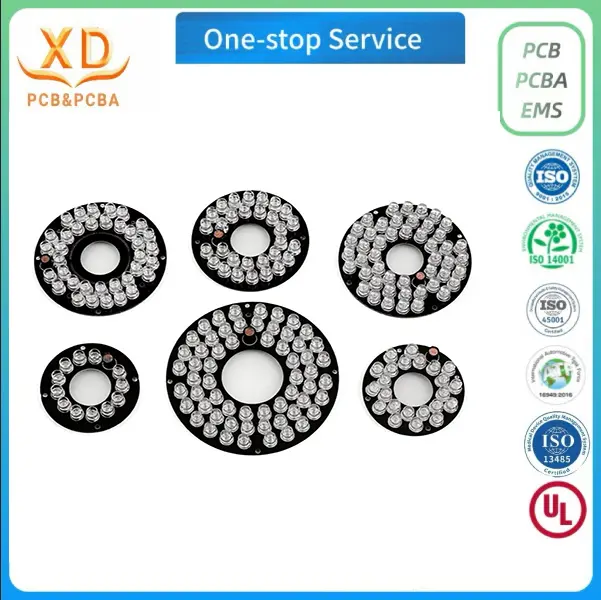
CCTV infrared ring lights are commonly used to provide supplementary illumination for security cameras in low-light or nighttime environments. Their LED modules may contain multiple infrared LEDs arranged in a circular or ring-shaped layout around the camera lens.
The PCB serves several important functions in this type of module:
Electrical connections: Provides conductive paths between LEDs, resistors, drivers, and other electronic components.
Component positioning: Keeps electronic components arranged according to the lighting module's circuit and mechanical design.
Heat transfer: Supports heat dissipation when an aluminum substrate structure is selected.
Mechanical integration: Matches the required circular dimensions, mounting positions, and housing structure.
Assembly support: Provides a suitable platform for soldering and mounting electronic components.
The specific circuit configuration depends on the LED arrangement, operating current, driver design, and control requirements. A custom board can be developed around the customer's circuit diagram, component list, mechanical drawings, or existing sample.
For CCTV infrared lighting projects, the board may be supplied as a bare PCB or as an assembled PCBA, depending on the customer's manufacturing plan.
Aluminum Substrate PCB Structure and Material Selection
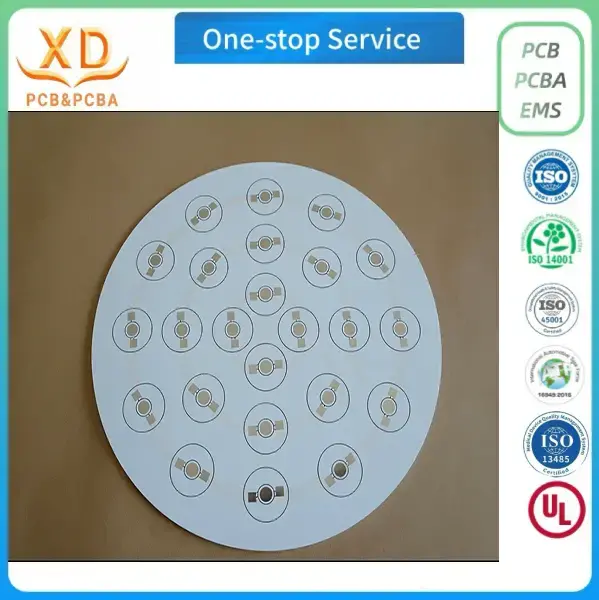
An aluminum substrate PCB, also known as an aluminum-based metal core PCB (MCPCB), is designed to improve heat transfer in electronic applications. It typically consists of three main layers.
| Layer | Main function |
|---|---|
| Copper circuit layer | Forms conductive paths and connects electronic components |
| Dielectric insulation layer | Electrically separates the circuit layer from the metal base while supporting heat transfer |
| Aluminum base layer | Provides mechanical support and helps transfer heat away from the circuit area |
This structure is useful in LED applications because LEDs generate heat during operation. If heat is not managed properly, excessive operating temperatures may affect component reliability and lighting performance.
Why Choose Aluminum for LED PCB Applications?
Aluminum offers a combination of thermal and mechanical properties that make it suitable for many LED lighting designs.
Heat dissipation support
The aluminum base provides a thermal path from the circuit area toward the board's mounting surface or connected heat-dissipation structure. This can help reduce heat accumulation when the PCB is integrated into a properly designed thermal system.
Mechanical support
The metal base provides a rigid foundation for the circuit layer. This can be useful for compact LED modules that require stable board positioning.
Design flexibility
Aluminum PCBs can be manufactured in different shapes and dimensions. Circular, annular, rectangular, and other customized outlines can be considered according to the product housing and installation requirements.
Application suitability
Aluminum substrate boards are commonly considered for LED lighting products where heat transfer is an important design factor.
The appropriate substrate, dielectric layer, copper thickness, and finished board thickness should be selected according to the electrical load, thermal requirements, mechanical structure, and manufacturing specifications of each project.
Thermal Management for LED Controller PCB
Thermal management is one of the main considerations when developing a PCB for a CCTV infrared LED ring light. The LEDs, driver components, and surrounding electronic parts can generate heat during continuous operation. The PCB design must work together with the housing and other thermal components to manage this heat.
LED Arrangement and Heat Distribution
The number and position of LEDs influence how heat is distributed across the board. A closely packed LED arrangement may create localized hot spots, particularly when the available board area is limited.
During layout development, engineers should consider:
LED quantity and spacing
Component power dissipation
Current distribution across LED branches
Available PCB surface area
Distance between heat-generating components
Contact between the PCB and the external housing
The objective is to avoid unnecessary heat concentration and provide a suitable thermal path for the assembled module.
Dielectric Layer Considerations
The dielectric layer is an important part of an aluminum substrate PCB. It provides electrical insulation between the copper circuit and the aluminum base while allowing heat to pass through the board structure.
Its thermal and electrical properties should match the application requirements. Selection should consider insulation performance, thermal conductivity, dielectric thickness, and the operating conditions of the LED module.
PCB and Housing Integration
The PCB does not dissipate heat independently. Its performance also depends on how it is installed in the finished product.
For example, the contact surface between the aluminum base and the lamp housing can influence heat transfer. Mounting pressure, surface flatness, thermal interface materials, and housing design may all affect the final thermal result.
For this reason, thermal evaluation should consider the complete LED module rather than the PCB alone. Temperature measurements under representative operating conditions can help identify potential design issues before mass production.
PCB Layout for Circular and Ring-Shaped LED Modules
CCTV infrared LED modules often use circular or annular PCBs to fit around the camera lens. These shapes require careful coordination between electrical layout and mechanical dimensions.
Custom Board Dimensions
The PCB outline should match the available installation space. Important mechanical details may include:
Outer diameter and inner opening diameter
Board thickness
Mounting holes and fixing positions
Component height limitations
Connector locations
Clearance around the camera lens and housing
Customers should provide dimensioned drawings or mechanical samples whenever possible. This helps reduce the risk of dimensional mismatches during assembly.
Electrical Layout Considerations
A circular board still needs to provide practical routing paths for power, control signals, and LED connections. The layout should account for current requirements, trace width, spacing, component placement, and connection points.
For multi-LED designs, the electrical configuration may use series, parallel, or combined connections. The appropriate arrangement depends on the LED specifications and driver circuit.
The design should also consider:
Current capacity of copper traces
Voltage drop along the circuit
Power distribution between LED branches
Polarity and connection identification
Electrical clearance and insulation requirements
Access for assembly and inspection
A well-planned layout helps support consistent assembly and reduces avoidable manufacturing problems.
Integrated or Separate Driver Design
Some LED modules place the driver circuit and LEDs on the same PCB, while others use a separate driver board.
| Design approach | Main characteristics | Considerations |
|---|---|---|
| Integrated LED and driver PCB | Combines LED and driver components on one board | Compact structure, but component placement and thermal management require careful planning |
| Separate LED and driver boards | Uses independent boards for lighting and power control | More flexibility in component arrangement, but requires additional connections and installation space |
The choice should be based on the product's electrical architecture, available space, thermal conditions, and assembly requirements.
LED PCB Aluminium Fabrication Process
The manufacturing process for an aluminum PCB involves several stages. Each stage contributes to the dimensional accuracy, circuit quality, and reliability of the finished board.
A typical production workflow includes the following steps:
1. Incoming material inspection
The aluminum base material, copper foil, and other production materials are checked against the applicable manufacturing requirements.
2. Material cutting
The material is cut to the required production dimensions before circuit processing.
3. Imaging
The circuit pattern is transferred to the copper surface according to the approved PCB design data.
4. Etching
Unwanted copper is removed to form the designed conductive pattern.
5. Solder mask printing
A solder mask is applied to the designated areas to protect the circuit and support the subsequent assembly process.
6. AOI inspection
Automated Optical Inspection is used to identify visible circuit pattern defects, such as potential opens or shorts.
7. Electrical testing
Electrical tests are performed according to the board's applicable requirements to check circuit connectivity and isolation.
8. Final quality inspection and packaging
Finished boards undergo final checks before packaging and shipment.
The exact production flow and inspection requirements may vary according to board structure, design complexity, and customer specifications.
Custom LED Controller PCB and PCBA Assembly Services
PCB fabrication is only one part of the manufacturing process. Many customers also require component sourcing and PCB assembly to receive a finished electronic board ready for integration.
For LED controller projects, the manufacturing scope may include the following services.
PCB Design and Layout Support
The design stage converts electrical and mechanical requirements into manufacturing data. Depending on the project, the required inputs may include circuit diagrams, Gerber files, BOM files, component specifications, and mechanical drawings.
Design review should pay attention to component footprints, trace routing, thermal considerations, mounting positions, and manufacturing feasibility.
Component Sourcing
Component sourcing involves obtaining the electronic parts required for the PCBA. The BOM should include clear part numbers, specifications, quantities, and approved alternatives where applicable.
Component availability and substitution requirements should be reviewed before production to reduce potential supply-chain delays or compatibility problems.
SMT Assembly
Surface Mount Technology (SMT) is commonly used to mount surface-mount components onto the PCB. The assembly process should follow the approved BOM, component placement data, and soldering requirements.
If the design includes through-hole components, additional assembly processes may be required.
Inspection and Testing
Inspection requirements should be defined according to the product's electrical design and quality objectives. Depending on the project, they may include visual inspection, AOI, electrical testing, and functional testing based on customer-provided test procedures.
The scope of PCBA inspection and testing should be confirmed before production rather than assumed to be identical for every order.
Applications of Custom Aluminum LED PCBs
Aluminum substrate PCBs are used in lighting products where thermal management and mechanical integration are important. Their suitability depends on the specific electrical and environmental requirements of the finished product.
CCTV Infrared Lighting
Circular aluminum PCBs can be used in CCTV infrared lamp modules. The board layout can be customized to accommodate LED positions, camera openings, mounting points, and housing dimensions.
LED Ring Light Modules
Ring-shaped LED boards are used in lighting assemblies that require a circular illumination arrangement. Custom board outlines and component positions can be developed according to the optical and mechanical design.
Residential and Commercial LED Lighting
Aluminum PCBs are also used in various residential and commercial lighting products. Board design depends on the LED configuration, power requirements, and fixture structure.
Outdoor and Industrial Lighting
Outdoor and industrial lighting products may operate under demanding environmental conditions. PCB selection should take into account the operating temperature, enclosure design, installation environment, and relevant protection requirements.
Automotive Lighting
Aluminum substrate PCBs may also be considered for certain automotive lighting applications. The final design and material selection should meet the applicable electrical, thermal, mechanical, and environmental requirements of the vehicle application.
Information Required for Custom PCB Orders
Accurate project information helps manufacturers evaluate feasibility, select suitable materials, and prepare quotations.
Before requesting a quotation for a custom LED controller PCB, customers should prepare the following information where available.
| Information | Why it matters |
|---|---|
| Gerber files | Defines the PCB circuit pattern and manufacturing data |
| BOM | Lists the components required for PCBA assembly |
| Circuit diagram | Explains electrical connections and circuit functions |
| Mechanical drawings | Specifies board dimensions, openings, and mounting positions |
| PCB material | Identifies the required substrate, such as aluminum |
| Board thickness | Defines the mechanical thickness requirement |
| Copper thickness | Helps determine circuit current capacity and manufacturing requirements |
| Surface finish | Specifies the required finish for exposed copper areas |
| Quantity | Supports production planning and quotation preparation |
| Testing requirements | Defines the inspection or functional testing scope |
If the design is still under development, customers can provide an existing sample, preliminary drawings, or a description of the intended application for an initial project review.
The manufacturer can then assess the available information and identify any missing details that need confirmation before production.
Selecting a Manufacturer for Aluminum LED PCB Projects
Choosing a suitable manufacturer involves more than comparing unit prices. The supplier should be able to evaluate the board structure, manufacturing requirements, and assembly needs of the project.
Several factors deserve attention.
Aluminum PCB manufacturing capability
Check whether the manufacturer can process the required aluminum substrate structure, board dimensions, copper circuit design, and surface finish.
Design and engineering support
A supplier with PCB design and engineering review capabilities can help identify potential issues involving circuit layout, component placement, and mechanical integration.
PCBA service scope
If the project requires assembled boards, confirm whether the supplier can support component sourcing, SMT assembly, and the required inspection or testing processes.
Quality control
Ask about the inspection stages used during fabrication and assembly. The quality plan should correspond to the product's technical requirements and agreed acceptance criteria.
Production flexibility
Prototype quantities and mass-production orders may have different planning requirements. Confirm the supplier's ability to handle the expected order volume and delivery schedule.
Communication and documentation
Clear communication about drawings, specifications, engineering changes, and inspection requirements helps reduce misunderstandings during production.
For a customized LED controller PCB project, these factors are important in establishing a practical manufacturing plan from initial design review to finished PCBA delivery.
A well-designed led controller pcb needs to meet electrical, thermal, and mechanical requirements at the same time. For CCTV infrared ring lights and other LED modules, an aluminum substrate PCB can provide a useful thermal path while supporting customized board shapes and component layouts.
The selection of substrate materials, dielectric properties, copper design, board dimensions, and assembly methods should be based on the actual requirements of the finished lighting product. Careful coordination between PCB fabrication and PCBA assembly also helps improve manufacturing consistency.
Xing Da supports customized aluminum PCB projects involving design, fabrication, component sourcing, and SMT assembly. For project evaluation or quotation, customers can prepare their circuit files, BOM, mechanical drawings, and production requirements and contact the Xing Da team for further discussion.
Label: