0755-27781532-8010; 02988446863














Jun 10, 2026
4-Layer Industrial Impedance PCB Manufacturer in China for OEM Projects
Sep 10
Intelligent Browse: 141
Industrial electronic equipment often requires circuit boards that can handle more than basic signal connection. Control systems, instrumentation, measurement equipment, and other industrial devices may contain multiple functional modules that need to communicate reliably within a limited PCB space. In these applications, a 4-layer impedance-controlled FR-4 PCB can provide a practical balance between circuit density, signal integrity, mechanical stability, and manufacturing efficiency.
For OEM buyers, the challenge is not simply finding a supplier that can manufacture a four-layer board. The more important question is whether the PCB manufacturer can consistently control the board structure, impedance, drilling, surface finish, testing, and production process according to the project requirements.
This is where choosing an experienced China PCB manufacturer can make a difference. Founded in 2011, XingDa Group is a professional manufacturer specializing in PCB, FPC, rigid-flex PCB, PCBA, and EMS production. Its manufacturing capabilities cover a wide range of PCB applications, including industrial control and instrumentation.
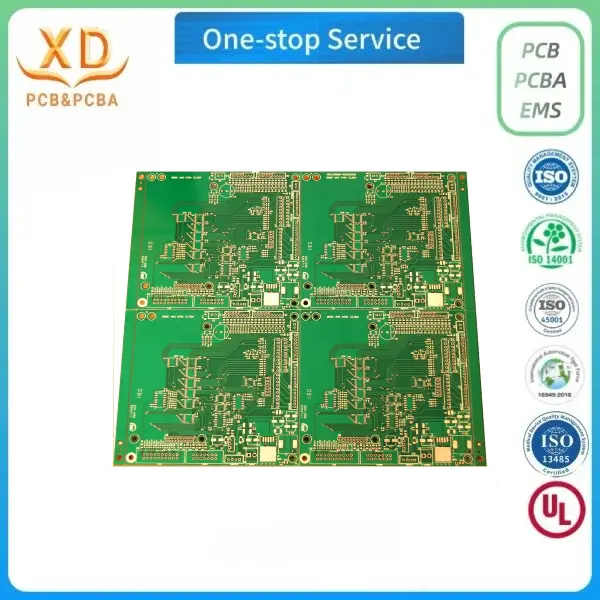
What Is a 4-Layer Impedance-Controlled PCB?
A four-layer PCB contains four conductive copper layers separated by insulating dielectric materials. Compared with a simple two-layer board, the additional internal layers provide more flexibility for routing power, ground, and signal traces.
For industrial electronics, this structure can be useful when the circuit contains multiple signal paths or when controlled impedance is required.
Impedance control means that the PCB manufacturer manages factors such as trace width, spacing, copper thickness, dielectric thickness, and material characteristics to achieve the required electrical impedance.
This is particularly relevant when the board carries signals where transmission characteristics affect system performance. Rather than treating impedance as an optional PCB specification, OEM projects should define it as part of the electrical design and manufacturing requirements.
XingDa's four-layer impedance-controlled FR-4 PCB is designed specifically for industrial control applications. The product is manufactured in Shenzhen using FR-4 as the rigid PCB base material, with a standard board thickness of 1.6 mm and a copper thickness range of 1–2 oz for this listed configuration.
Why FR-4 Is Suitable for Industrial Control Boards
FR-4 remains a widely used material for rigid PCBs because it provides a practical combination of electrical insulation, mechanical strength, and manufacturing compatibility.
For industrial control equipment, the PCB may need to remain stable while operating inside a control cabinet, instrument enclosure, machine, or measurement system. The board may also need to accommodate connectors, integrated circuits, sensors, communication interfaces, and other components within a defined mechanical footprint.
A four-layer FR-4 structure gives designers additional routing options compared with a conventional two-layer board.
For example, a multilayer layout can separate certain signal and power routing areas more effectively, while dedicated ground structures can help support signal integrity. The exact stack-up, however, should always be determined according to the electrical design rather than assuming that every four-layer board requires the same structure.
Impedance Control Requires Manufacturing Precision
For OEM buyers, “impedance controlled” should not simply be treated as a keyword on a PCB quotation.
Actual impedance performance is affected by several manufacturing variables. These can include:
- Trace width and spacing
- Copper thickness
- Dielectric thickness
- Layer stack-up
- Material characteristics
- Etching accuracy
- Registration between layers
- Surface finish
- Manufacturing tolerances
XingDa's product specification lists a minimum trace width and spacing of 0.075 mm for the rigid PCB configuration. It also supports a minimum metallized hole diameter of 0.2 ± 0.075 mm. These specifications give OEM customers a reference for discussing routing density and drilling requirements during the engineering stage.
For a new project, customers should provide the required impedance values and relevant design files so that the manufacturer can evaluate the stack-up and production parameters before manufacturing.
Applications in Industrial Control Equipment
Industrial control is one of the main application scenarios listed for XingDa's four-layer impedance-controlled PCB.
A control board may need to process signals from sensors, communicate with other modules, control actuators, and connect with an industrial host system. These functions can require different routing requirements on the same PCB.
A four-layer design can provide more routing space while keeping the board within a relatively compact form factor.
For OEM equipment manufacturers, this can be useful in applications such as machine control systems, automation equipment, industrial controllers, and other electronic systems where stable signal transmission is important.
The goal is not necessarily to make the PCB more complicated. Instead, the additional layers should be used to solve specific routing, grounding, power distribution, and signal integrity requirements.
PCB Solutions for Instrumentation and Measurement Equipment
Instrumentation presents another important application for impedance-controlled PCBs.
Surveying and mapping instruments, measurement equipment, and other precision electronic systems can involve multiple signal acquisition and data-processing modules. The PCB needs to provide reliable electrical connections while maintaining the required mechanical and electrical characteristics.
XingDa states that its four-layer impedance-controlled PCBs are used in surveying and mapping instrumentation, supporting signal acquisition and data processing within multi-module electronic systems.
In this type of application, PCB manufacturing quality becomes part of the overall equipment design. Small variations in board dimensions, hole positions, layer registration, or impedance characteristics can create additional engineering work during assembly and testing.
A manufacturer with established process controls can therefore be valuable when the PCB is part of a larger industrial instrument.
Manufacturing Processes and Inspection
A reliable industrial PCB supplier should be able to explain how the board will be manufactured and inspected, rather than focusing only on the finished appearance.
For XingDa's four-layer impedance-controlled FR-4 PCB, the listed manufacturing capabilities include:
- Impedance control
- Blind and buried vias
- CNC routing
- Laser cutting
- V-scoring
- Die cutting
- Multiple surface finishing options
The listed surface finishes include immersion gold, ENIG, HASL, immersion tin, OSP, and electroplated Ni/Au.
Testing is another important part of the process. XingDa lists 100% open/short electrical testing, characteristic impedance testing, thermal shock testing, tinning testing, and reinforcement peel-strength reliability testing for this PCB product.
For OEM buyers, these details are more useful than simply asking whether a supplier “has good quality.” They provide specific points that can be included in a technical specification or supplier evaluation checklist.
Why Work With a China PCB Manufacturer?
China has a mature electronics manufacturing supply chain, making it possible for OEM customers to source PCB fabrication and subsequent PCBA services from the same manufacturing group.
For an industrial electronics project, this can reduce the number of suppliers involved between PCB design and finished assembly.
XingDa's PCB manufacturing capabilities cover FR-4 and other PCB categories, while the company also provides FPC, rigid-flex PCB, PCBA, and EMS services. Founded in 2011, XingDa Group operates three production bases with a combined area of more than 36,000 square meters. Its stated monthly capacity includes 100,000 square meters of PCB production and 12,000 square meters of FPC production.
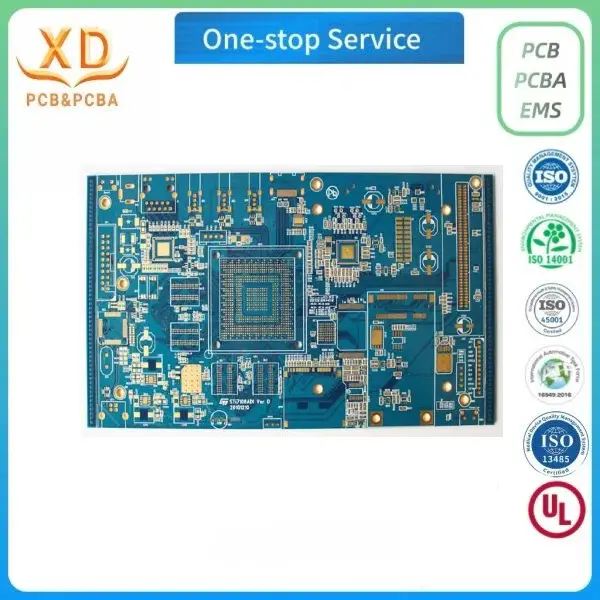
The company also operates a PCBA factory with eight SMT lines and six DIP lines. Its EMS services include PCBA, housing/case molding, packing, assembly, and functional testing.
For an OEM customer, these capabilities can be useful when a project needs to progress from bare PCB manufacturing to assembled boards and final functional testing.
What OEM Buyers Should Provide to a PCB Manufacturer
A clear engineering package makes the manufacturing process much easier to manage.
For a four-layer impedance-controlled PCB project, buyers should normally provide:
Gerber files:
These define the PCB copper layers, solder mask, silkscreen, and board outline.
Drill files:
Hole sizes and positions need to correspond with the final mechanical design.
Impedance requirements:
Specify the required controlled-impedance traces and target values where applicable.
Stack-up requirements:
If the project has a predefined stack-up, the manufacturer should review it before production.
Material requirements:
FR-4 type, thickness, copper weight, and other material specifications should be confirmed.
Surface finish:
The finish should be selected according to component assembly and application requirements.
Testing requirements:
Electrical testing and any additional reliability tests should be agreed upon before production.
This information allows the manufacturer to identify potential manufacturing issues before the PCB reaches mass production.
A Practical Approach to 4-Layer Industrial PCB Sourcing
Choosing a four-layer industrial PCB manufacturer should not be based on one specification alone.
For OEM projects, a better approach is to evaluate the complete manufacturing chain: engineering review, material control, multilayer fabrication, impedance control, drilling, surface treatment, electrical testing, and production capacity.
XingDa's 4-layer impedance-controlled FR-4 PCB is positioned for industrial control and instrumentation applications, with support for controlled impedance and several specialized PCB processes.
At the company level, its PCB, FPC, PCBA, and EMS capabilities allow customers to work with a broader electronics manufacturing platform rather than sourcing every process separately.
For OEM buyers developing industrial controllers, instruments, measurement equipment, or other electronic systems, this combination of product-specific engineering and broader manufacturing capability can make the PCB sourcing process more straightforward.
The right PCB is ultimately the one that meets the electrical design, mechanical structure, testing requirements, and production consistency of the finished product. For four-layer industrial applications where impedance control matters, working with a manufacturer that can connect these requirements throughout the production process is an important part of building a reliable supply chain.
Label: