0755-27781532-8010; 02988446863














Sep 09, 2026
96% Alumina Ceramic PCB: Why Choose a China Manufacturer for Power Electronics?
Sep 02
Intelligent Browse: 153
Power electronics are becoming increasingly demanding. As current levels rise and electronic components become more compact, PCB materials need to handle heat, electrical stress, and long-term operating conditions more effectively. This is one reason why alumina ceramic PCBs are increasingly used in power modules, LED systems, industrial electronics, automotive electronics, and other applications where thermal management is critical.
A 96% alumina ceramic PCB combines an alumina-based ceramic substrate with a conductive copper circuit layer. Compared with conventional FR-4 boards, ceramic substrates offer different thermal and electrical characteristics that can be advantageous in high-temperature and high-power applications.
For overseas OEM and electronics manufacturers, China is an important sourcing market for ceramic PCBs. However, choosing the right manufacturer requires more than checking whether a supplier offers alumina ceramic boards. The supplier's material capability, DPC process, copper thickness, engineering support, inspection procedures, and production consistency all need to be considered.
What Is a 96% Alumina Ceramic PCB?
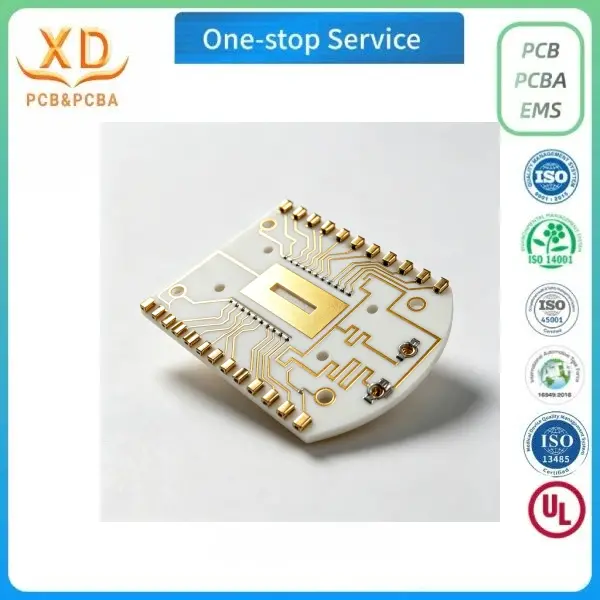
A 96% alumina ceramic PCB uses ceramic material containing approximately 96% alumina (Al₂O₃) as the substrate.
The ceramic substrate provides electrical insulation while also helping transfer heat away from components. A conductive copper layer is then formed on the ceramic surface to create the required circuit pattern.
This structure makes alumina ceramic PCBs particularly useful where both electrical insulation and thermal management are required.
Typical applications include:
- Power semiconductor modules
- LED lighting and LED power systems
- Industrial power supplies
- Motor control equipment
- Automotive electronics
- High-current electronic systems
- RF and high-frequency applications
- Power conversion equipment
The actual suitability of a 96% alumina substrate depends on the circuit design and operating conditions, so material selection should be made together with the PCB manufacturer during the engineering stage.
Why Is Alumina Ceramic Useful for Power Electronics?
Heat is one of the major challenges in power electronics. When components such as power semiconductors operate at high current, electrical energy is converted into heat. If this heat cannot be effectively managed, excessive temperature can affect component performance and product reliability.
Ceramic substrates provide a different thermal path from conventional organic PCB materials.
Alumina has useful thermal and electrical insulation characteristics, making it suitable for applications where components generate significant heat but the substrate still needs to maintain electrical isolation.
For this reason, a ceramic PCB can be considered when the application requires a combination of:
Thermal management + electrical insulation + dimensional stability + high-temperature capability
However, thermal performance is not determined by the substrate alone. Copper thickness, circuit layout, component attachment, heat dissipation structure, and the final system design all influence the actual thermal performance.
DPC Technology and Alumina Ceramic PCBs
For many ceramic PCB applications, the method used to form the copper circuit is just as important as the ceramic substrate itself.
DPC, or Direct Plated Copper, is a ceramic PCB manufacturing technology that forms copper on the ceramic substrate through a plating process. It can be used to create customized conductive patterns and support circuit designs for power electronic applications.
DPC technology is particularly relevant when engineers need a ceramic substrate with controlled copper thickness and a relatively precise circuit structure.
When evaluating a DPC ceramic PCB manufacturer, OEM customers should ask about:
- Available ceramic materials
- Copper thickness range
- Copper plating process
- Circuit pattern capability
- Hole and via processing
- Surface treatment
- Dimensional tolerances
- Inspection procedures
These details are more useful than simply asking whether a manufacturer "makes ceramic PCBs."
Why Thick Copper Matters in Power Applications
Power electronics often involve higher current than conventional control circuits. As a result, copper thickness becomes an important design consideration.
Thick copper can provide a larger conductive cross-section, which can help support higher current requirements and reduce electrical resistance in suitable circuit designs.
When thick copper is combined with an alumina ceramic substrate, the resulting ceramic circuit board can be considered for applications where both current handling and thermal management are important.
However, thick copper manufacturing also creates additional production challenges. The manufacturer needs to control copper formation, circuit dimensions, etching or plating processes, bonding, and surface quality.
A capable supplier should therefore evaluate the complete PCB structure rather than treating copper thickness as an isolated specification.
Why Choose a China Manufacturer?
China has a mature electronics manufacturing supply chain covering PCB materials, components, assembly, machining, testing, and related manufacturing services. This gives Chinese PCB manufacturers access to a broad industrial ecosystem.
For international OEM customers, another advantage is the ability to work with manufacturers that have experience producing customized circuit boards according to customer drawings and technical specifications.
However, not every Chinese PCB supplier has the same ceramic PCB capabilities.
When selecting a manufacturer, buyers should evaluate several practical factors.
1. Ceramic Material Capability
Confirm whether the manufacturer can provide the required alumina ceramic material and whether the material specifications are consistent from batch to batch.
For a 96% alumina project, material composition and substrate properties should be clearly defined in the technical documentation.
2. Copper Processing Capability
Ask about DPC, copper thickness, circuit dimensions, and surface treatment.
For power electronics, copper quality can have a direct influence on current carrying and thermal performance.
3. Engineering Support
A reliable manufacturer should be able to review Gerber files, mechanical drawings, layer information, hole specifications, and application requirements.
Good engineering communication can identify potential production problems before prototype manufacturing begins.
4. Quality Control
Ceramic PCBs require appropriate inspection throughout production.
Depending on the design, inspection may include dimensional checks, visual inspection, copper thickness verification, electrical testing, and other process-specific controls.
For OEM customers, it is also important to understand how the manufacturer manages production consistency between prototype and subsequent batches.
What Should OEM Buyers Provide to a Manufacturer?
A ceramic PCB manufacturer can evaluate a project more efficiently when the customer provides complete technical information.
Before contacting a supplier, prepare:
- Gerber files
- PCB dimensions
- Alumina substrate requirements
- Copper thickness
- Circuit pattern
- Hole specifications
- Surface finish
- Operating temperature
- Current and voltage requirements
- Component information
- Prototype quantity
- Expected production requirements
The manufacturer can then determine whether the design is suitable for its existing processes and whether any modifications are recommended.
This approach is much more practical than selecting a supplier solely from a product catalog.
Xingda Group: A China PCB Manufacturing Partner
For companies looking for a Chinese PCB manufacturer, the supplier's manufacturing background is worth considering.
Xingda Group was established in 2011 and specializes in the production of various types of circuit boards. Its product portfolio includes PCB solutions for different application requirements.
You can learn more about the company's manufacturing and PCB capabilities through its official website.
For buyers specifically researching ceramic circuit boards, Xingda also provides dedicated ceramic PCB products. Its 96% alumina ceramic PCB product page can serve as a reference when evaluating the product structure and potential application.
For an OEM project, the most useful next step is to provide the actual design files and technical requirements to the manufacturer. This allows the engineering team to assess material selection, copper structure, circuit layout, and production feasibility based on the specific application.
96% Alumina Ceramic PCB vs. Conventional FR-4
The choice between ceramic and conventional PCB materials depends on the application.
| Feature | 96% Alumina Ceramic PCB | Conventional FR-4 PCB |
|---|---|---|
| Substrate | Alumina ceramic | Glass-reinforced epoxy |
| Thermal performance | Suitable for thermal management applications | Generally lower thermal conductivity |
| Electrical insulation | High | High |
| High-temperature applications | Suitable for many demanding applications | More limited depending on material grade |
| Mechanical stability | Good dimensional stability | Good for general PCB applications |
| Typical use | Power, LED, industrial, high-temperature electronics | General electronics and control circuits |
This does not mean ceramic PCBs should replace FR-4 in every application. FR-4 remains a practical material for many conventional electronic products.
Ceramic PCB technology becomes more attractive when thermal management, high-temperature operation, electrical insulation, or power density becomes a major design concern.
Questions to Ask Before Choosing a Supplier
Before starting an OEM project, buyers can use the following checklist:
Material:
Can the manufacturer provide 96% alumina ceramic substrates with consistent specifications?
Copper:
Can the supplier support the required DPC process and copper thickness?
Design:
Can its engineering team review Gerber files and provide manufacturability feedback?
Quality:
What inspection and testing procedures are used during production?
Production:
Can the supplier maintain consistent quality between prototype and mass production?
Customization:
Can the ceramic PCB be manufactured according to the customer's dimensions, circuit pattern, holes, and surface treatment requirements?
A manufacturer that can answer these questions clearly is generally easier to work with during OEM development.
Conclusion
96% alumina ceramic PCBs are a practical option for power electronics where thermal management, electrical insulation, and stable operation are important. When combined with DPC copper processing and suitable copper thickness, ceramic circuit boards can support a range of demanding electronic applications.
For overseas OEM buyers, China offers a strong manufacturing environment and a wide supplier base. The key is to select a manufacturer based on actual engineering and production capabilities rather than product descriptions alone.
Xingda Group, established in 2011, has focused on PCB manufacturing and provides different circuit board solutions for customers. For an OEM project involving a 96% alumina ceramic PCB, buyers can review the manufacturer's ceramic PCB capabilities and then submit their specific drawings and technical requirements for engineering evaluation.
The right supplier should be able to support the entire process—from material selection and PCB design review to prototype production, quality inspection, and stable production. This makes it easier to develop a ceramic PCB that matches the actual requirements of power electronic equipment.
Label: