0755-27781532-8010; 02988446863














Sep 22, 2026
Why Choose a China Manufacturer for Custom Long LED Aluminum PCB?
Sep 23
Intelligent Browse: 131
Long LED lighting fixtures are widely used in commercial spaces, industrial facilities, retail stores, corridors, warehouses, offices, and other environments where a continuous and uniform light source is required. Unlike compact LED modules, these products often use long, narrow circuit boards that need to fit precisely inside a linear housing.
For this type of lighting, the PCB is not only responsible for connecting the LEDs. It also needs to work with the mechanical structure of the fixture and help manage heat generated during operation. This is why aluminum PCB technology is commonly considered for long LED lighting applications.
For overseas lighting companies, sourcing a custom long LED aluminum PCB from a China manufacturer can provide access to flexible manufacturing capabilities and PCB production experience. The key, however, is to select a supplier that can manufacture according to the actual dimensions, electrical requirements, thermal conditions, and assembly method of the lighting product.
Xing Da Group, founded in 2011, is a professional group company specializing in the production of various types of circuit boards. Its manufacturing portfolio covers PCB, FPC, rigid-flex PCB, ceramic PCB, aluminum PCB, metal PCB, and PCBA. Visit XDPCBA to learn more about its PCB manufacturing capabilities.
Why Long LED Fixtures Need a Different PCB Approach
A standard rectangular LED PCB is not always suitable for a linear lighting fixture.
Consider a commercial linear light installed above a retail display. The fixture may have a narrow aluminum housing several hundred millimeters long. The LEDs need to be distributed along the entire length of the lamp, while the PCB must fit into the available internal space.
If the board is too wide, it may not fit the housing. If the LED positions do not match the optical design, the light distribution can be affected. If the PCB construction does not suit the thermal requirements, heat management may become a problem.
A long aluminum PCB allows the circuit layout to be developed around the actual fixture.
The result can be a narrow, continuous LED circuit rather than multiple smaller boards connected together.
Aluminum as the Metal Core
One of the practical reasons aluminum PCBs are used in LED lighting is their metal-core construction.
LEDs convert electrical energy into light, but part of the energy is also released as heat. In a high-density LED fixture, the PCB needs to work together with the lighting housing and heat-dissipation structure.
An aluminum substrate provides a metal base within the PCB construction. This makes aluminum PCB technology particularly relevant to LED applications where thermal management is an important design consideration.
For a long lighting board, the PCB can also be mechanically positioned along the length of the fixture, creating a continuous circuit platform for the LEDs.
The goal is not simply to choose an aluminum PCB. The aluminum material, dielectric layer, copper thickness, board dimensions, LED density, and fixture structure all need to be considered as one system.
Custom Length and Width Matter in Real Projects
One of the biggest differences between standard LED boards and custom long aluminum PCBs is the dimensional requirement.
Lighting manufacturers may need different board widths for different housings. One project may use a narrow board for a slim linear lamp, while another may require a wider board for a commercial high-bay fixture.
The XDPCBA product page lists a maximum processing size of 1200 × 600 mm, with finished board thicknesses from 0.4 mm to 3.0 mm and copper thicknesses from 1 oz to 6 oz. The product is manufactured in Shenzhen, China.
These specifications give buyers room to define the board around the actual lighting structure rather than selecting a standard board and modifying the fixture around it.
For OEM projects, the PCB drawing should therefore be developed together with the mechanical drawing of the lamp.
Matching the PCB to the LED Arrangement
A long circuit board is only useful if the LED positions match the optical and mechanical design.
Before production, the buyer should confirm:
Overall PCB length
PCB width
Board thickness
LED package
LED quantity
LED spacing
Circuit configuration
Connector position
Mounting holes
Cutting or separation requirements
Power input location
For example, a corridor lighting product may require a narrow board with evenly distributed SMD LEDs. A high-bay lighting product may use a longer aluminum PCBA with a connector at one end.
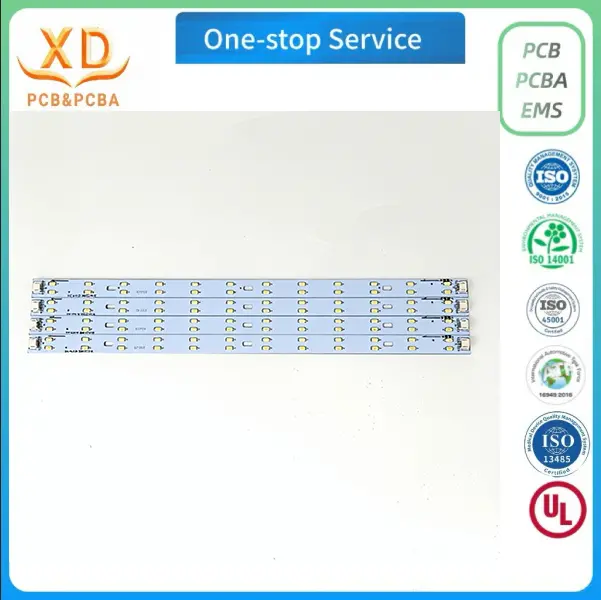
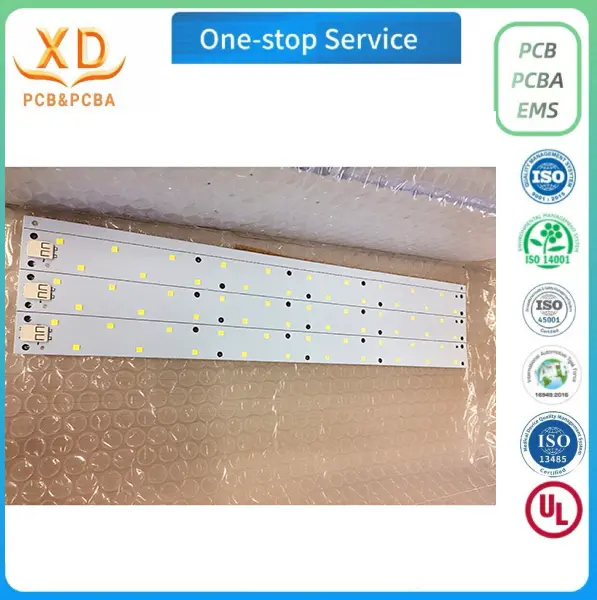
The XDPCBA product page specifically shows a slim assembled long LED PCBA designed for narrow-width linear light housings and also presents a long aluminum PCBA with quick-plug connectors for industrial high-bay lighting.
This type of application-focused customization is more useful to an OEM buyer than simply ordering a generic aluminum PCB.
Material Selection Should Follow the Application
Not every aluminum alloy or PCB construction is automatically suitable for every lighting project.
The referenced XDPCBA long LED aluminum PCB uses 5052-H32 or 6061-T6 aluminum alloy.
When developing a new lighting fixture, the manufacturer and buyer should discuss the intended operating conditions before confirming the material.
Important factors include:
Fixture size
Installation environment
LED power
Operating temperature
Mechanical structure
Mounting method
Required board thickness
Heat dissipation structure
This is particularly important for industrial lighting, where fixtures may operate for extended periods and may be installed in demanding environments.
Copper Thickness Is Another Important Design Variable
The copper layer affects the electrical characteristics of the PCB and needs to be selected according to the circuit design.
XDPCBA lists copper thickness from 1 oz to 6 oz for this long LED aluminum PCB product. The website also specifies a minimum trace width and line spacing of 0.15 mm.
The appropriate copper thickness should not be selected simply because a higher value sounds better. The actual choice should take into account current requirements, trace width, LED configuration, board structure, and manufacturing requirements.
For an OEM project, providing the Gerber files and electrical specifications allows the PCB manufacturer to review the design before production.
Where Custom Long LED Aluminum PCBs Can Be Used
The long aluminum PCB format is suitable for many lighting products where a linear circuit layout is required.
Typical applications include:
Commercial Linear Lighting
Retail stores, corridors, offices, supermarkets, and other commercial spaces often use long linear fixtures. A narrow aluminum PCB can be designed to fit directly into the lamp housing.
Industrial High-Bay Lighting
Industrial facilities and warehouses often require high-output lighting fixtures. A long aluminum PCBA with a suitable connector arrangement can simplify installation and internal wiring.
LED Tube Lights
Long narrow PCBs are also suitable for LED tube light structures, where the board needs to fit inside the tube and distribute LEDs along its length.
Cabinet and Display Lighting
Retail displays, shelves, cabinets, and counters may require slim lighting modules with specific lengths. Custom PCB dimensions can help manufacturers match the circuit to the available space.
Architectural Linear Lighting
Architectural lighting projects often involve customized fixture dimensions. A PCB designed around the actual profile can be more practical than combining several standard boards.
Why Work Directly with a China PCB Manufacturer?
For an overseas lighting company, the advantage of working directly with a China PCB manufacturer is the ability to communicate technical requirements with the production side.
Instead of purchasing through multiple layers of distribution, the buyer can discuss the PCB specifications directly with the factory.
This is useful when a project involves changes to:
Board dimensions
Aluminum substrate
Copper thickness
Circuit layout
Surface treatment
LED assembly
Connector design
Packaging
A manufacturer with broader PCB capabilities can also support other circuit board requirements as a lighting company develops different products.
According to its official website, XDPCBA provides PCB, FPC, rigid-flex PCB, ceramic PCB, aluminum PCB, and metal PCB manufacturing, as well as PCBA, component, assembly, functional testing, and packing services.
This broader manufacturing capability can be useful for OEM customers that need more than bare PCB fabrication.
From Bare Aluminum PCB to Finished LED PCBA
Some lighting manufacturers prefer to purchase bare PCBs and complete LED assembly themselves. Others want the PCB manufacturer to deliver a finished PCBA.
Both models can make sense depending on the customer's production system.
A bare PCB gives the lighting manufacturer control over component sourcing and assembly. A finished PCBA can reduce the number of internal production steps.
For example, the long aluminum PCBA shown on the XDPCBA product page can be supplied as a narrow assembled LED board for linear lighting or as an assembled board with quick-plug connectors for industrial high-bay applications.
When requesting a quotation or engineering review, buyers should therefore clearly state whether they need:
Bare aluminum PCB
SMD LED assembly
Complete LED PCBA
Connector installation
Component sourcing
Functional testing
Custom packaging
Clear requirements at the beginning help prevent misunderstandings later in the project.
Production Control Is Critical for Long Boards
Long PCBs require consistent manufacturing across the entire board.
If the board dimensions are inconsistent, the PCB may not fit correctly into the aluminum housing. If the circuit pattern is defective, a section of LEDs may fail. If assembly positioning is inaccurate, the LED arrangement may not align with the optical structure.
XDPCBA describes a production process covering raw material incoming inspection, cutting, imaging, etching, solder mask printing, AOI inspection, electrical testing, final quality inspection, and packaging. The company states that both custom samples and mass-volume orders are supported for its aluminum PCB production.
For lighting OEMs, this production control is particularly important when a product moves from prototype to regular production.
Surface Finish and Assembly Requirements
The surface finish should also be selected according to the customer's assembly process.
The long LED aluminum PCB product supports OSP, HASL, immersion gold, immersion tin, and immersion silver surface treatments.
There is no single surface finish that is automatically appropriate for every LED lighting project. The choice should be discussed together with the soldering process, component requirements, storage conditions, and production standards.
This is another area where direct communication with the PCB manufacturer can help ensure that the final board matches the assembly process.
What Should an Overseas Buyer Prepare?
A well-prepared technical package makes the initial communication much more efficient.
For a custom long LED aluminum PCB project, the buyer should ideally provide:
Gerber files
PCB mechanical drawing
Required board length and width
Aluminum substrate requirements
Board thickness
Copper thickness
LED model and quantity
LED spacing
Connector requirements
Mounting-hole information
Surface finish
Bare PCB or PCBA requirement
BOM if assembly is required
Testing requirements
Packaging specifications
If the project is still under development, a sample fixture or housing drawing can also help the PCB manufacturer understand the physical requirements.
Why Consider Xing Da Group?
Xing Da Group was founded in 2011 and focuses on manufacturing different types of circuit boards. Its official website presents the company as a professional PCB and PCBA manufacturer in Shenzhen, with capabilities covering multiple PCB technologies and electronic manufacturing services.
For long LED lighting applications, its custom aluminum PCB product provides several practical manufacturing options, including 5052-H32 and 6061-T6 aluminum alloy substrates, 0.4–3.0 mm finished board thickness, 1–6 oz copper thickness, and a maximum listed processing size of 1200 × 600 mm.
The company also demonstrates application-specific long LED PCBA designs, including slim narrow-width boards for linear lighting and quick-plug connector versions for high-bay lighting.
For overseas lighting companies, these capabilities can be relevant when developing custom commercial or industrial LED fixtures.
Final Considerations for LED Lighting Buyers
Choosing a China manufacturer for a custom long LED aluminum PCB should start with the actual lighting fixture rather than the PCB alone.
Define the housing dimensions, LED arrangement, power requirements, thermal conditions, connector location, and assembly process first. Then select the aluminum PCB structure around those requirements.
A suitable manufacturer should be able to review the design, manufacture prototypes, provide the required PCB construction, perform production inspections, and support the transition to regular orders.
For lighting companies looking for a manufacturing partner, XDPCBA provides a broad PCB and PCBA manufacturing platform, while its Custom Long LED Aluminum PCB is specifically designed for long-form LED lighting applications.
For commercial linear lights, industrial high-bay fixtures, LED tube lights, cabinet lighting, and other long LED products, a custom aluminum PCB can be developed around the real dimensions and electrical requirements of the finished product. Working directly with an experienced China PCB manufacturer can make this process more practical from prototype development through repeat production.
Label: