0755-27781532-8010; 02988446863













Sep 02, 2026
OEM LED Aluminum PCB for Tube Lamps: Custom Manufacturing Solutions from China
Oct 10
Intelligent Browse: 0
Introduction
LED tube lamps are widely used in offices, factories, warehouses, retail stores, schools, and other commercial environments. For lighting manufacturers, producing a reliable LED tube is not just about selecting efficient LED chips. The circuit board must fit the lamp housing, support the component layout, manage heat, and maintain consistent electrical performance throughout production.
An aluminum printed circuit board (MCPCB) is a practical option for many LED tube designs because its metal base helps transfer heat away from the LED circuit area. However, the right board still depends on the lamp's power requirements, dimensions, LED arrangement, and thermal design.
For lighting brands and OEM manufacturers looking for a supplier in China, a custom aluminum PCB manufacturer can help turn an existing design into a board suited to the final product. Founded in 2011, Xingda Group specializes in various circuit boards, including PCB, FPC, rigid-flex PCB, PCBA, and electronic manufacturing services. Buyers can learn more about its capabilities through the Xingda Group official website.
This article explains what to consider when sourcing OEM LED aluminum PCBs for tube lamps, how customization affects manufacturing, and how to prepare a more effective inquiry for a Chinese supplier.
1. Why Aluminum PCBs Are Used in LED Tube Lamps
LEDs convert electrical energy into light, but some of the energy is also released as heat. If heat is not managed properly, the operating temperature of the LED module can rise, potentially affecting light output, component life, and overall product reliability.
An aluminum PCB typically consists of a conductive copper circuit layer, an electrically insulating dielectric layer, and an aluminum base. The aluminum base provides mechanical support and helps conduct heat toward the lamp's thermal management structure.
For LED tube lamps, this structure offers several practical benefits:
Heat transfer: The metal base helps move heat away from the LED mounting area.
Mechanical support: A rigid aluminum board can suit the long, narrow geometry of many tube-light housings.
Layout customization: The circuit pattern can be designed to match the LED spacing and electrical requirements.
Manufacturing consistency: A defined PCB design helps maintain component positions and board dimensions across production batches.
Aluminum does not replace the need for proper thermal design. The dielectric layer, LED power, component placement, lamp housing, and contact between the PCB and the surrounding structure all affect the final thermal result. OEM buyers should evaluate the board as part of the complete lighting assembly rather than treating the PCB material as the only factor.
2. Custom PCB Design for Different LED Tube Formats
A standard PCB may not fit every LED tube product. Lighting manufacturers often need a board that matches an existing housing or a new lamp design.
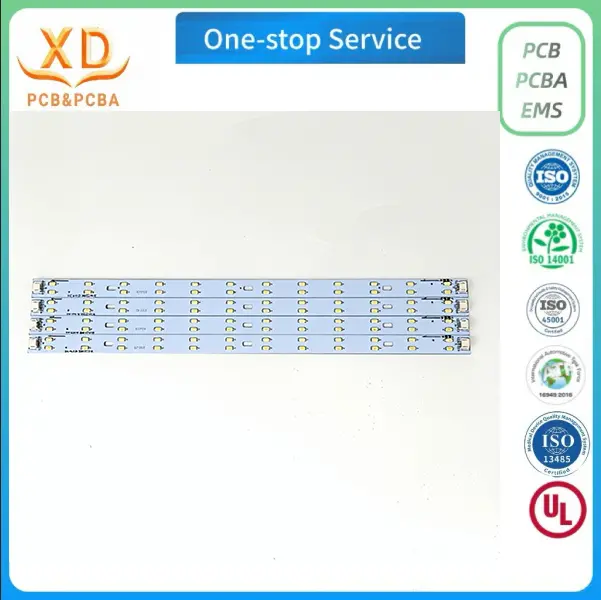
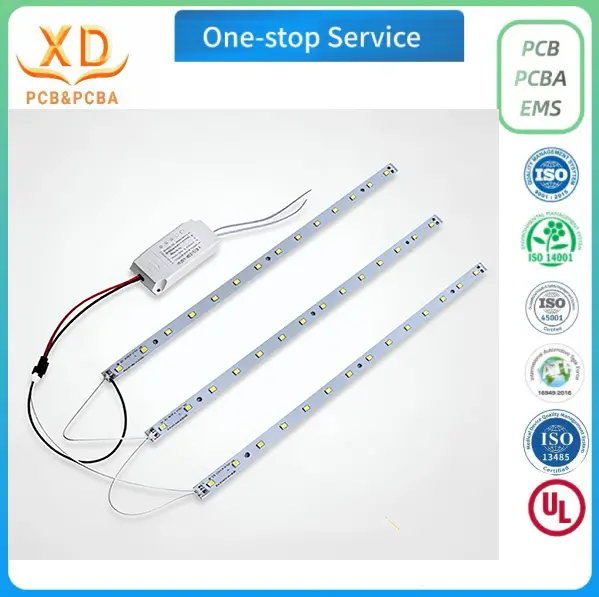
For example, T8 and T10 replacement tube lamps may use a long, narrow metal-core PCB. Its length, width, mounting holes, LED spacing, and component positions must correspond with the lamp's mechanical structure. Even a small dimensional mismatch can complicate assembly or affect how the board sits inside the housing.
A custom LED tube light aluminum PCB can be developed around the customer's requirements, including:
Overall board length and width
Board thickness and aluminum substrate specifications
LED package type and spacing
Copper circuit layout and electrical connections
Mounting holes, cutouts, and edge requirements
Surface finish and soldering process
Bare PCB or assembled PCBA delivery
When a customer already has a proven design, the manufacturer can work from the supplied production files. For a new project, mechanical drawings and preliminary electrical requirements can help establish the necessary design parameters before manufacturing begins.
The product page for custom LED tube light aluminum PCBs and OEM LED designs provides a relevant starting point for buyers evaluating a long-strip aluminum circuit board for tube-lamp applications.
3. Bare Aluminum PCB or Fully Assembled LED Board?
One of the first decisions an OEM buyer needs to make is whether to purchase a bare aluminum PCB or a completed PCBA.
Supply option | What it includes | When it is useful |
|---|---|---|
Bare aluminum PCB | Manufactured board with the required circuit pattern and finish | The buyer already has an assembly line and sources components independently |
Assembled LED PCBA | PCB populated with specified electronic components | The buyer wants the board and component assembly coordinated by one supplier |
Customized OEM solution | Manufacturing based on the customer's design documents and requirements | The buyer needs a production partner for a defined lighting product |
For bare boards, the manufacturer mainly needs to follow the PCB design and fabrication specifications. For assembled boards, the process also involves component sourcing or customer-supplied components, SMT placement, soldering, and any agreed inspection or testing.
The product information for Xingda's custom LED tube light aluminum PCB includes options for both bare metal-core PCBs and full PCBA assembly, with examples of 2835 SMD LEDs, MOSFETs, and passive components. The actual component list and assembly configuration should be confirmed against the buyer's design.
For a lighting brand, receiving an assembled board can simplify coordination between PCB fabrication and electronics assembly. However, it is still important to confirm the bill of materials, component specifications, approved alternatives, and inspection requirements before production starts.
4. Key Specifications to Confirm Before Manufacturing
A detailed technical inquiry helps reduce repeated revisions and makes it easier for a manufacturer to assess the project.
Substrate and board dimensions
Confirm the aluminum substrate requirements, finished board thickness, overall dimensions, and dimensional tolerances. The PCB must fit the tube housing and work with the product's mounting method. If the lamp uses a particular internal support or heat-transfer structure, the manufacturer should receive the relevant mechanical drawing.
Copper thickness and circuit layout
Copper thickness, trace width, spacing, and circuit geometry need to suit the electrical requirements of the design. These specifications should be reviewed together rather than selected independently. The manufacturer should work from the approved Gerber files and clarify any fabrication limitations before releasing the board to production.
Surface finish
Surface finish affects solderability, storage, and compatibility with the assembly process. Common PCB finishes include HASL, OSP, immersion gold, immersion tin, and immersion silver. The appropriate choice depends on the design, component assembly requirements, and the customer's manufacturing process.
Thermal requirements
Buyers should share relevant information about LED power, expected operating conditions, and the intended thermal path. Where necessary, thermal evaluation should consider the LED package, dielectric layer, aluminum base, lamp housing, and the way the board is installed. A manufacturer should not promise a particular operating temperature based on the aluminum substrate alone.
Inspection and acceptance criteria
Before placing an order, specify the required electrical checks, visual inspection criteria, dimensional tolerances, and any assembly-level tests. Clear acceptance criteria make it easier for both sides to evaluate the finished product consistently.
5. How Xingda Supports Custom LED PCB Manufacturing
Choosing a manufacturer involves more than checking whether a supplier can produce one particular board. Buyers should also consider production experience, communication, quality procedures, and the supplier's ability to support future orders.
Xingda Group was founded in 2011 and is headquartered in Shenzhen, China. Its manufacturing scope covers PCB, FPC, rigid-flex PCB, PCBA, and EMS services. According to the company's published information, it operates three production bases covering more than 36,000 square meters.
The company lists monthly production capacity of 100,000 square meters for PCB and 12,000 square meters for FPC. Its PCBA facility includes eight SMT lines and six DIP lines. These capabilities are relevant to buyers who may need different types of circuit boards or assembled electronic products across multiple projects.
For LED tube manufacturers, the practical value lies in finding a supplier that can work to documented requirements. A custom board may need to follow a customer's established design exactly, while a new product may require discussion of dimensions, materials, manufacturing tolerances, and assembly needs.
Xingda's broader product range also gives buyers a point of contact for other circuit board requirements as their product portfolio expands. Details about its manufacturing scope and company background are available on the Xingda PCB and PCBA manufacturer website.
6. Quality Control: What Buyers Should Ask About
A board that passes an initial visual check may still need further inspection before it is ready for assembly. For LED tube lamps intended for repeat production, quality control should cover the stages that matter to the specific design.
A typical aluminum PCB manufacturing workflow may include:
Incoming material inspection: Check the supplied substrate and relevant materials against the production requirements.
Cutting and imaging: Prepare the board material and transfer the circuit pattern.
Etching and solder mask processing: Form the circuit and apply the specified protective coating where required.
Automated optical inspection: Inspect visible circuit features for manufacturing defects.
Electrical testing: Check for open and short circuits according to the agreed test requirements.
Final quality checks: Verify relevant dimensions, appearance, surface finish, and packaging before shipment.
The exact process depends on the board design and the supplier's manufacturing flow. For assembled PCBA orders, additional checks may be needed for component placement, solder joints, polarity, and functional performance.
OEM customers should ask which checks are included, what records can be provided, and how nonconforming boards are handled. For repeat orders, keeping the approved design files, revision numbers, and acceptance criteria consistent is especially important. This helps prevent an engineering change from being mistaken for the original production specification.
7. How to Prepare an OEM Inquiry for a Chinese Aluminum PCB Factory
A well-prepared inquiry saves time during engineering review and helps the manufacturer understand the actual scope of work.
For a bare aluminum PCB order, buyers should prepare:
Gerber files and drill files
PCB dimensions and mechanical drawings
Aluminum substrate and copper thickness requirements
Surface finish and solder mask requirements
Required quantity and target production schedule
Inspection and acceptance criteria
For a fully assembled LED PCBA, also provide the BOM, pick-and-place file, LED part numbers, component specifications, and assembly drawings where applicable. If the design is still being developed, explain the intended application and any unresolved requirements so the manufacturer can identify what needs clarification.
It is also useful to distinguish between a prototype order and repeat production. Samples allow the buyer to verify fit, assembly compatibility, and performance before approving larger production batches. Any design changes identified during sample evaluation should be documented and reflected in the final manufacturing files.
For projects that require manufacturing according to an existing design, Xingda's OEM manufacturing service explains the documentation used for PCB and PCBA production. Buyers can use this as a reference when organizing their project files.
8. Why Consider a China-Based OEM Manufacturer?
For overseas lighting companies, sourcing from China can provide access to an established electronics manufacturing supply chain. The main consideration should be whether a supplier's actual capabilities match the project's technical and production requirements.
A suitable manufacturing partner should be able to review the design documents, clarify specifications, follow the approved revision, conduct agreed inspections, and communicate production issues promptly. For buyers managing multiple lighting products, a supplier with experience across PCB fabrication and PCBA assembly may also simplify coordination between manufacturing stages.
The best sourcing decision is not necessarily the supplier offering the broadest list of services. It is the supplier that can consistently manufacture the required board, document the agreed quality checks, and support the project's expected production volume.
Xingda Group's experience in circuit board manufacturing since 2011, combined with its PCB, PCBA, and EMS capabilities, makes it a supplier worth evaluating for custom LED tube-light PCB projects. Buyers can start by reviewing the custom LED tube light aluminum PCB product details and sharing their technical files for a project-specific assessment.
Conclusion
OEM LED aluminum PCBs for tube lamps need to satisfy several requirements at once: accurate dimensions, a suitable circuit layout, effective thermal integration, compatible assembly processes, and consistent manufacturing quality. Choosing the board material is only one part of the decision; the complete design and its operating environment must also be considered.
Working with an experienced Chinese PCB manufacturer can help lighting brands coordinate custom fabrication and, where needed, PCBA assembly through a more organized manufacturing process. By preparing clear design files, defining acceptance criteria, and validating samples before repeat production, OEM buyers can make supplier evaluation more efficient and reduce avoidable production issues.
For companies developing T8, T10, or other LED tube-lamp products, Xingda Group offers a starting point for discussing custom aluminum PCB manufacturing based on specific project requirements.
Label: