0755-27781532-8010; 02988446863














Sep 02, 2026
Why Choose a China Manufacturer for Custom LED Flexible PCB Boards?
Sep 22
Intelligent Browse: 137
LED lighting products are becoming increasingly compact and application-specific. From flexible LED strips and tube lights to cabinet lighting, architectural lighting, and decorative panels, manufacturers often need a circuit board that can fit a particular shape rather than a standard rigid PCB.
This is where a custom LED flexible PCB becomes useful. Instead of designing the lighting product around a fixed circuit board, the PCB can be developed according to the required dimensions, LED arrangement, bending conditions, and installation structure.
For overseas lighting companies, choosing a China manufacturer for this type of PCB can provide access to a mature electronics manufacturing supply chain and a wide range of PCB technologies. However, the real advantage is not simply the location of the factory. What matters is whether the manufacturer can understand the application, control the production process, and consistently manufacture the required board.
Xing Da Group, founded in 2011, is a professional group company specializing in the production of different types of circuit boards. Its manufacturing portfolio covers PCB, FPC, rigid-flex PCB, ceramic PCB, aluminum PCB, metal PCB, and PCBA products. Visit XDPCBA to learn more about its PCB and PCBA manufacturing capabilities.
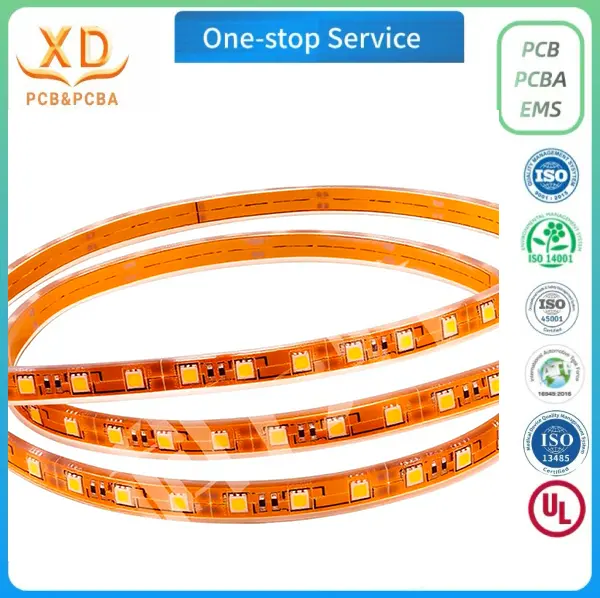
Why Flexible PCB Is Suitable for LED Lighting
Traditional rigid PCBs are suitable for flat structures, but many LED lighting products require more installation flexibility.
For example, an LED strip may need to run around a curved display, inside a narrow lighting channel, along a cabinet edge, or through an irregular housing. A rigid board can make these designs difficult or require additional mechanical structures.
A flexible PCB allows the circuit to follow the intended shape of the lighting product.
The custom LED flexible PCB offered by XDPCBA uses PI Polyimide or PET substrate options. The product is designed for applications including LED tube lights, LED strips, curved installation LED modules, indoor and outdoor decorative lighting, cabinet lighting, and architectural accent lighting.
This makes flexible PCB technology particularly useful for lighting manufacturers that need to balance circuit performance with installation requirements.
1. Custom Dimensions for Different LED Products
One of the main reasons to work with a custom PCB manufacturer is that lighting products rarely have exactly the same structure.
An LED tube light may require a long and narrow circuit. An LED strip may need a flexible circuit that follows a curved housing. A cabinet lighting system may require a specific board length and connection position.
Instead of adapting the product to a standard PCB, manufacturers can develop the circuit around the actual product.
During the engineering stage, buyers can provide:
Gerber files
PCB drawings
LED arrangement
Board dimensions
Connector locations
Required bending areas
Copper thickness
Surface finish
Assembly requirements
The factory can then review the design before production and identify manufacturing issues that may affect the final board.
2. Flexible Materials for Curved Lighting Applications
Material selection is an important part of flexible PCB manufacturing.
The XDPCBA product specification lists PI Polyimide and PET substrate options. Finished board thickness is listed from 0.4 mm to 3.0 mm, while copper thickness ranges from 1 oz to 6 oz.
The appropriate construction depends on the application.
For example, a flexible LED module installed inside a curved housing may place greater emphasis on mechanical flexibility. A lighting application carrying higher current may require closer consideration of copper thickness, trace width, heat generation, and power distribution.
Therefore, the PCB should not be selected based only on whether it is described as “flexible.” The complete electrical and mechanical requirements need to be evaluated together.
3. Support for Different LED Lighting Applications
A China PCB manufacturer with broader production capabilities can be useful when a lighting company develops multiple products.
For example, one product line may use flexible LED PCBs for curved strip lighting, while another uses aluminum PCBs for high-power LED modules.
XDPCBA's product portfolio includes PCB, FPC, rigid-flex PCB, ceramic PCB, aluminum PCB, metal PCB, and PCBA manufacturing. Its website also identifies OEM, ODM, and EMS capabilities.
For an overseas buyer, this means different circuit requirements can potentially be discussed with the same manufacturing organization rather than being divided between several specialized suppliers.
This can simplify technical communication, sampling, quality control, and production management.
4. Bare PCB or Complete PCBA
Not every customer wants to purchase only the bare flexible circuit.
For LED lighting manufacturers, the final requirement may be a complete flexible LED PCBA with LEDs and other electronic components already assembled.
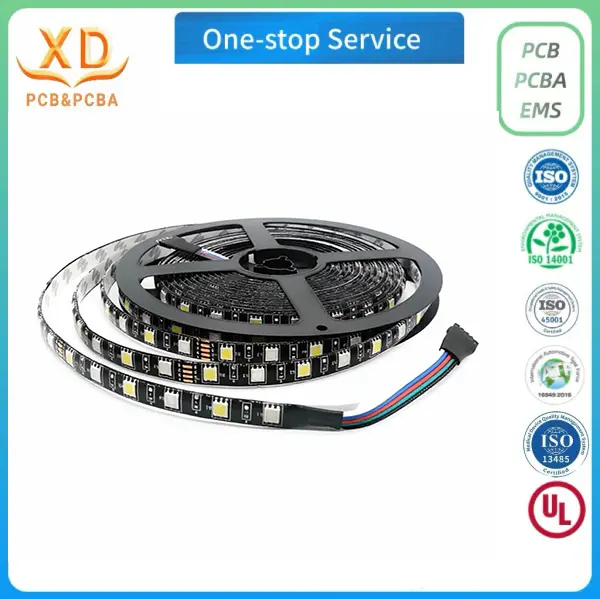
The XDPCBA product page states that both bare FPC and finished PCBA are available for relevant LED lighting applications. It also describes a finished flexible LED strip PCBA solution for multi-color lighting applications, including reel-packed products for installation.
This gives buyers two practical sourcing options.
If the customer already has an established SMT production line, purchasing bare PCBs may be appropriate.
If the customer wants to reduce the number of manufacturing steps handled internally, a finished PCBA can be considered.
The right option depends on the customer's production structure, component sourcing strategy, assembly process, and quality requirements.
5. More Flexible Manufacturing Specifications
LED lighting products can have very different PCB requirements. A supplier needs to be able to accommodate these differences rather than offering only one fixed construction.
For the referenced XDPCBA product, the listed process specifications include single-board, insulation-board, and double-sided board configurations. The page also lists a minimum trace width and line spacing of 0.15 mm and a maximum processing size of 1200 × 600 mm.
Surface treatment options include OSP, HASL, immersion gold, immersion tin, and immersion silver.
These options allow the PCB construction to be matched more closely to the customer's assembly and application requirements.
For a buyer, the important point is to confirm the actual specification before production rather than assuming that every flexible LED PCB uses the same material, copper thickness, surface finish, or manufacturing process.
6. A Complete Production Process Matters
A flexible PCB may look simple when viewed as part of an LED strip, but its reliability depends on multiple production stages.
A professional manufacturer needs to control the process from raw material inspection through final packaging.
XDPCBA states that its LED PCB production process includes incoming raw material inspection, cutting, imaging, etching, solder mask printing, AOI inspection, electrical testing, final quality inspection, and packaging.
For international buyers, this is an important consideration.
When a lighting product enters regular production, small inconsistencies in PCB dimensions, circuit patterns, soldering areas, or electrical continuity can create assembly problems. Process inspection therefore needs to be part of the manufacturing system rather than something considered only after a problem occurs.
7. Better Fit for OEM and ODM Development
Custom LED lighting companies often have their own product structures, branding, housing designs, and electrical specifications.
A standard PCB may work for a general-purpose lighting product, but it may not fit an OEM product where the circuit must follow a specific housing or LED arrangement.
This is where direct communication with the PCB manufacturer becomes important.
XDPCBA identifies customized design services as part of its ODM business and provides PCB, components, assembly, testing, and packing capabilities through its broader manufacturing services.
For an OEM project, the manufacturer can therefore be involved earlier in the process.
Instead of waiting until the product design is finished, buyers can discuss PCB manufacturability during the development stage.
This can help identify issues such as:
Excessive bending areas
Inappropriate board thickness
Insufficient trace width
Difficult component placement
Connector positioning problems
Assembly limitations
Unnecessary manufacturing complexity
Resolving these issues before mass production is generally easier than changing the PCB after the lighting product has already entered assembly.
8. China Manufacturing Can Support International Buyers
China has a large electronics manufacturing ecosystem covering PCB fabrication, components, SMT assembly, testing, packaging, and related manufacturing services.
For overseas buyers, this can be useful when the project requires more than PCB fabrication.
For example, a lighting company may begin with a flexible PCB prototype, then move to an assembled PCBA, followed by repeat production. Having access to PCB and PCBA manufacturing within the same supply chain can make the transition more straightforward.
However, buyers should still evaluate each supplier individually. A manufacturer should be assessed based on its actual production capabilities, communication, quality control, engineering support, sample process, and ability to meet the customer's technical specifications.
Choosing a China manufacturer should therefore be based on manufacturing fit rather than simply geographical location.
What Should You Send to a China LED Flexible PCB Manufacturer?
Before contacting a supplier, preparing complete technical information can make the development process much more efficient.
For a custom LED flexible PCB project, buyers should ideally provide:
Gerber files or PCB design files
Board dimensions and thickness
LED model and quantity
LED spacing and circuit arrangement
Required copper thickness
Substrate requirements
Connector or terminal specifications
Surface finish
Bending requirements
Bare PCB or PCBA requirements
Component BOM if assembly is required
Testing requirements
Packaging requirements
If the project is still at the development stage, a drawing or physical sample can also be useful.
The manufacturer can then determine which specifications need to be confirmed before tooling and production.
Why Work with Xing Da Group?
Founded in 2011, Xing Da Group focuses on the manufacturing of different types of circuit boards and related electronic manufacturing services.
Its official website describes the company as a professional PCB and PCBA manufacturer based in Shenzhen, with capabilities covering PCB, FPC, rigid-flex PCB, ceramic PCB, aluminum PCB, metal PCB, PCBA, assembly, functional testing, and packing.
For LED lighting applications, its custom flexible PCB solution provides options for PI Polyimide and PET substrates, different board thicknesses and copper thicknesses, multiple surface treatments, and both bare PCB and finished PCBA configurations.
This combination is relevant for lighting companies developing LED strips, LED tube lights, cabinet lights, decorative lighting, and curved lighting modules.
Final Thoughts
Choosing a China manufacturer for custom LED flexible PCB boards is not simply about finding a supplier that can produce a flexible circuit. The more important question is whether the manufacturer can match the PCB to the actual lighting product and maintain consistent production quality.
For OEM and ODM lighting projects, buyers should look at material options, board dimensions, copper thickness, circuit design, surface finish, bending requirements, assembly capability, inspection procedures, and long-term production support.
With its PCB and PCBA manufacturing capabilities, Xing Da Group provides a manufacturing platform for customers that need customized circuit boards for different electronic and LED lighting applications.
For companies developing a new LED strip, LED tube light, panel lighting system, or curved lighting module, XDPCBA's custom LED flexible PCB solution can be considered as part of the supplier evaluation process. The key is to provide clear technical requirements and work with the manufacturer from the design stage through prototype validation and regular production.
Label: