0755-27781532-8010; 02988446863













Jun 10, 2026
Custom SMD LED Aluminum PCB Manufacturer in China for LED Lighting
Sep 18
Intelligent Browse: 1
LED lighting modules are becoming increasingly compact, while many applications still require stable operation and effective thermal management. For manufacturers developing LED bulbs, panel lights, downlights, automotive interior lamps, commercial lighting, or specialized LED modules, the PCB needs to do more than connect components. It also needs to fit the mechanical design and provide a suitable thermal path for the LED components.
This is one reason aluminum PCBs are widely used in LED lighting. With an aluminum metal base, the board can help transfer heat away from the LED area while providing a rigid platform for SMD components.
For OEM buyers looking for a custom SMD LED aluminum PCB manufacturer in China, XingDa Group provides aluminum PCB manufacturing for different LED lighting applications. Founded in 2011, XingDa is a professional group company specializing in PCB, FPC, rigid-flex PCB, PCBA, and EMS manufacturing. Its headquarters are in Shenzhen, China.
Why Use Aluminum PCB for SMD LED Lighting?
Heat is one of the practical issues that needs to be considered when designing an LED lighting module.
An SMD LED generates heat while operating. If the heat cannot be transferred away efficiently, the temperature of the LED module can increase. The actual thermal performance of a finished lighting product depends on many factors, including LED power, PCB structure, thermal interface materials, housing design, heat sink, airflow, and operating conditions.
An aluminum PCB provides a metal substrate that can be integrated into this thermal management structure.
Compared with a conventional PCB design, an aluminum-based circuit board can be particularly useful when the LED module requires:
- A compact circuit layout
- A rigid mounting platform
- Heat transfer from the LED area
- Customized board dimensions
- Multiple SMD LED positions
- Integration with a metal housing or heat sink
For lighting manufacturers, the objective is not simply to select an aluminum PCB. The PCB needs to be designed around the complete LED module.
Custom SMD LED Aluminum PCB from XingDa
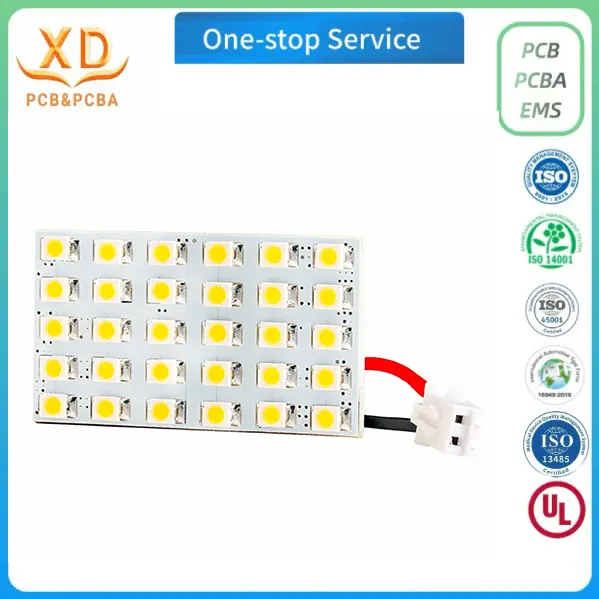
XingDa's Custom SMD LED Aluminum PCB for LED Lighting Module is manufactured in Shenzhen, China. The product uses 5052-H32 or 6061-T6 aluminum alloy, with finished board thicknesses from 0.4 mm to 3.0 mm and copper thickness from 1 oz to 6 oz.
The available process specifications include single-sided boards, insulated boards, and double-sided boards. The listed minimum trace width and line spacing are 0.15 mm, while the maximum processing size is 1200 × 600 mm. Surface treatment options include OSP, HASL, immersion gold, immersion tin, and immersion silver.
For buyers developing a new lighting product, these options make it possible to select the PCB structure according to the actual electrical and mechanical requirements rather than adapting the product to a fixed standard board.
You can view the detailed product specifications on the Custom SMD LED Aluminum PCB for LED Lighting Module page.
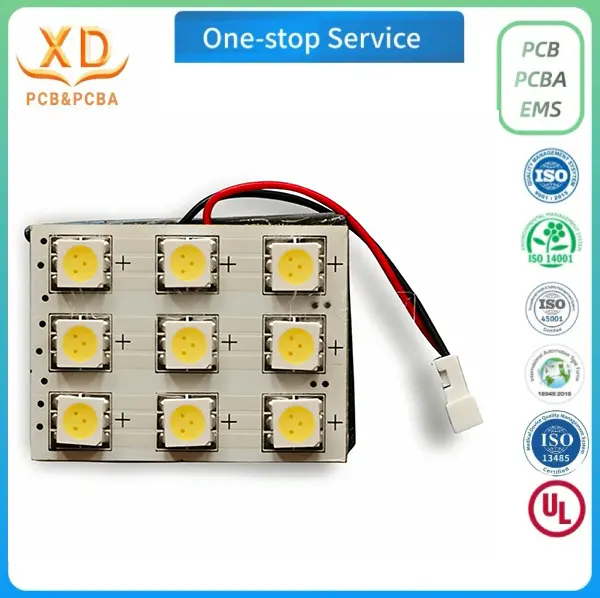
Applications for SMD LED Aluminum PCBs
One advantage of aluminum PCB manufacturing is its suitability for different LED lighting formats.
Indoor LED Lighting
Aluminum PCBs can be used for LED bulbs, tube lights, panel lights, downlights, ceiling lights, and cabinet lights. XingDa lists household indoor lighting as one of the application areas for its aluminum PCB products.
For these products, the PCB can be customized to match the shape and dimensions of the lighting housing. The circuit layout can also be developed according to the selected SMD LED package and electrical design.
Commercial and Outdoor Lighting
LED street lights, tunnel lights, flood lights, wall washers, high-bay lights, and plant grow lights can have higher thermal requirements than some indoor lighting products.
For these applications, the aluminum substrate can form part of the product's overall heat management structure. However, PCB material alone does not determine the final thermal performance. The LED specification, thermal interface, housing, heat sink, and installation environment also need to be considered.
XingDa's product information specifically identifies commercial and outdoor lighting as application scenarios for its aluminum PCB solutions.
Automotive LED Lighting
Automotive lighting modules often require compact PCB structures. XingDa lists automotive interior lighting applications such as reading lamps and license plate lamps for its aluminum PCB products.
For OEM projects, board dimensions, mounting points, component positions, copper thickness, and surface finish can be determined according to the vehicle lighting module.
Security and Special-Purpose LED Modules
Not every LED application uses a conventional rectangular circuit board. CCTV infrared lighting, auxiliary lighting, and other special-purpose LED modules may require circular, irregular, or application-specific PCB shapes.
XingDa's aluminum PCB production capabilities include support for circular and irregular-shape LED PCBs, with options for bare PCB or finished PCBA.
This is useful when a lighting manufacturer already has a mechanical housing and needs the PCB to follow its internal geometry.
What Can Be Customized?
When sourcing an SMD LED aluminum PCB, customization normally starts with the board design.
For an OEM lighting project, buyers may need to specify:
Board dimensions:
The PCB can be designed according to the available space inside the lamp housing.
Aluminum material:
XingDa's listed options include 5052-H32 and 6061-T6 aluminum alloy.
Board thickness:
The available finished board thickness is 0.4–3.0 mm.
Copper thickness:
The listed range is 1–6 oz.
Circuit layout:
The trace pattern, SMD pad arrangement, mounting holes, and other features can be developed according to the customer's PCB design.
Surface finish:
Available options include OSP, HASL, immersion gold, immersion tin, and immersion silver.
These specifications should be selected based on the LED module's electrical requirements, assembly process, mechanical structure, and expected operating environment.
Manufacturing Process for Custom Aluminum PCBs
A good aluminum PCB design still needs a controlled manufacturing process to become a consistent finished board.
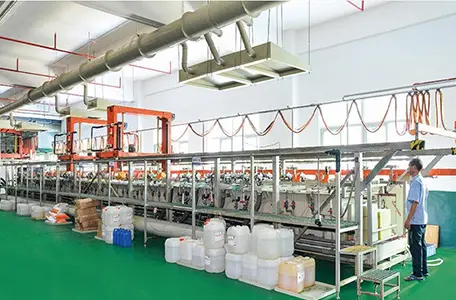
According to XingDa's product information, its aluminum PCB production line covers raw material incoming inspection, cutting, imaging, etching, solder mask printing, AOI inspection, electrical testing, final QA, and packaging. The company also supports both custom samples and mass-volume orders.
For an LED lighting OEM, this is important because the same PCB may need to be produced repeatedly for different production batches. Dimensional consistency, circuit pattern accuracy, surface quality, and electrical performance all need to remain within the agreed specifications.
The production process should therefore be discussed before mass production rather than only after a problem appears during assembly.
Why Work with a China Aluminum PCB Manufacturer?
China has an established electronics manufacturing supply chain, making it a common sourcing location for PCB and PCBA projects.
For international lighting companies, the practical advantage of working directly with a specialized manufacturer is the ability to discuss PCB design, materials, production requirements, inspection, and assembly with the same supplier.
XingDa Group was founded in 2011 and specializes in various circuit board products, including PCB, FPC, rigid-flex PCB, PCBA, and EMS. The company is headquartered in Shenzhen and operates three modern production bases covering more than 36,000 square meters. Its published information lists monthly production capacity of 100,000 square meters for PCB and 12,000 square meters for FPC.
Its PCBA factory includes 8 SMT lines and 6 DIP lines, with one SMT line listed at 210,000 CPH. The EMS scope includes PCBA, housing/case mold, packing, assembly, and function testing.
For a lighting manufacturer, this broader capability can be useful when a project moves from bare aluminum PCB production to assembled LED modules.
What Should Buyers Prepare Before Ordering?
To make communication with a PCB manufacturer more efficient, an LED lighting company should prepare as much technical information as possible.
A typical custom PCB inquiry should include:
- Gerber files and drill files
- PCB dimensions and thickness
- Aluminum alloy requirements
- Copper thickness
- SMD LED model and component layout
- Required surface finish
- Mounting holes or mechanical requirements
- Required PCB quantity
- Bare PCB or PCBA requirements
- Electrical testing requirements
If the design is still under development, the buyer can also provide a mechanical drawing and a description of the lighting application's operating conditions.
This gives the manufacturer enough information to evaluate whether the proposed aluminum PCB structure is suitable before production begins.
From PCB Prototype to Production
For new LED lighting products, it is often useful to separate development into several stages.
First, the PCB design is reviewed against the LED layout and mechanical structure. Next, prototype boards can be produced for assembly and functional testing. After the design is confirmed, production specifications can be standardized for larger orders.
This process helps identify practical issues early, such as an unsuitable board thickness, incorrect mounting-hole position, component clearance problems, or incompatibility with the intended assembly process.
XingDa's aluminum PCB product page indicates that both custom samples and mass-volume orders are supported.
For overseas OEM customers, this provides a straightforward path from custom PCB development to repeat production.
A Practical Aluminum PCB Solution for LED Lighting
For SMD LED lighting manufacturers, an aluminum PCB is not simply a different circuit board material. It is part of the electrical, mechanical, and thermal design of the complete lighting module.
The right solution depends on the LED components, board dimensions, copper thickness, aluminum material, heat-dissipation structure, assembly method, and operating environment.
XingDa's PCB and PCBA manufacturing services cover a broad range of circuit board requirements, while its custom SMD LED aluminum PCB is designed for LED lighting modules with multiple material, thickness, copper, and surface-finish options.
For lighting OEMs and electronic product manufacturers, the most practical approach is to provide the PCB design and application requirements first, then work with the manufacturer to confirm the material, structure, manufacturing process, and testing requirements.
Label: