0755-27781532-8010; 02988446863















Sep 09, 2026
Automotive PCBA Manufacturing: Key Requirements for ECU and BMS Boards
Nov 09
Intelligent Browse: 0
Automotive electronics place demanding requirements on printed circuit board assembly. Automotive PCBA used for electronic control units, battery management systems, sensors, body control systems, and other vehicle electronics needs to combine accurate component placement, stable electrical connections, appropriate testing, and consistent production processes.
For OEM buyers, selecting an automotive PCB assembly supplier involves more than comparing assembly prices. The supplier needs to understand the board's electrical function, component requirements, thermal conditions, mechanical environment, production volume, and testing needs. ECU and BMS boards also have different functional priorities, so their PCB design and assembly considerations cannot be treated as identical.
Xing Da's current product structure includes Automotive Electronics PCBA, with ECU PCBA and BMS Main Control PCBA listed under this category. Its automotive PCBA pages also describe OEM/EMS services covering PCB fabrication, component sourcing, SMT and through-hole assembly, functional testing, and production from prototype to mass manufacturing.
What Is Automotive PCBA Manufacturing?
Automotive PCBA manufacturing refers to the production of assembled printed circuit boards used in vehicle electronic systems. The process can include PCB fabrication, component procurement, SMT placement, through-hole assembly, soldering, inspection, electrical testing, functional testing, and final assembly depending on the project.
The finished PCBA may serve different functions within a vehicle.
Examples include:
Electronic control units
Battery management systems
Automotive sensors
Body control systems
Vehicle lighting control
HVAC control
Infotainment systems
Power management modules
ADAS-related electronic modules
EV control electronics
Each application creates different technical requirements.
An ECU may require stable processing, communication, input and output control, and reliable operation in a vehicle environment. A BMS board may place greater emphasis on voltage and current measurement, battery monitoring, control functions, and power-related circuit design.
The manufacturing process therefore needs to follow the actual function of the board rather than relying on a generic PCBA production approach.
ECU PCBA and BMS PCBA: Different Manufacturing Priorities
ECU and BMS boards are both automotive electronics assemblies, but they are designed for different system functions.
| Board Type | Primary Function | Typical Manufacturing Considerations |
|---|---|---|
| ECU PCBA | Vehicle electronic control and communication | MCU, communication interfaces, sensors, power management, connectors, testing |
| BMS PCBA | Battery monitoring and management | Measurement circuits, control logic, communication, power management, thermal considerations |
| Sensor PCBA | Signal acquisition and processing | Signal conditioning, precision components, compact layout, environmental requirements |
| Body control PCBA | Vehicle body functions | Multiple inputs/outputs, connectors, switching circuits, control logic |
| ADAS-related PCBA | Vehicle sensing and assistance functions | Sensor interfaces, signal processing, communication, inspection and reliability requirements |
The exact circuit structure depends on the vehicle system and customer design.
For OEM projects, the PCB assembly supplier should therefore receive sufficient information about the board's intended application before production begins.
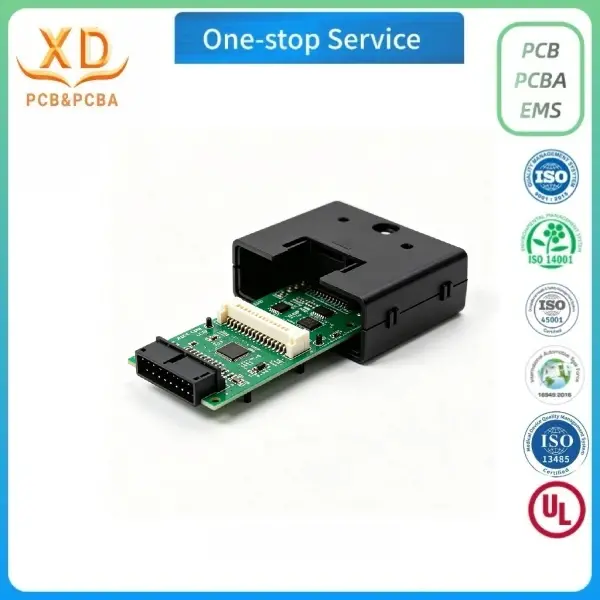
Key Requirements for Automotive PCB Assembly
Automotive PCB assembly requires close coordination between PCB design, components, assembly processes, and testing.
Several areas deserve particular attention.
Component selection
Automotive boards may contain microcontrollers, memory devices, power-management components, sensors, communication interfaces, connectors, and passive components.
Component selection should be based on the customer's electrical and environmental requirements. The PCB assembler should also confirm availability, lifecycle status, package type, and approved alternatives where applicable.
For long-term automotive programs, component sourcing can become a major production issue. A component that is easy to obtain during prototype production may become difficult to source when production volumes increase.
This makes component planning an important part of automotive PCBA manufacturing.
PCB design
The PCB layout needs to support the electrical and mechanical requirements of the application.
Design considerations may include:
Signal routing
Power distribution
Grounding
Thermal management
Component placement
Connector location
Clearance
Layer structure
Manufacturing tolerances
Test-point placement
The final design should also be reviewed for manufacturability before production.
Assembly process
Automotive boards may use both SMT and through-hole components depending on the design.
SMT supports high-density component placement and is widely used for modern electronic assemblies. Through-hole assembly can still be appropriate for certain connectors or components that require specific mechanical support.
The correct assembly process depends on the board design rather than on the automotive application alone.
PCB Design Considerations for ECU PCBA
ECU boards often combine processing, communication, power management, sensing, and control functions on one assembly.
This creates several PCB design challenges.
Power and signal separation
Power circuits and sensitive signal circuits may have different routing requirements. The PCB layout should be developed to reduce unwanted interference and maintain appropriate signal paths.
Communication interfaces
Automotive electronic systems may communicate with other control modules through vehicle communication networks. The PCB design needs to accommodate the interfaces specified by the customer's system architecture.
Connector placement
Connectors provide the electrical and mechanical interface between the ECU and the vehicle harness or other systems. Their location can affect both PCB layout and enclosure design.
Thermal considerations
Power components and processors may generate heat during operation. Component placement and copper distribution should be considered together with the product's thermal structure.
Testing
ECU assemblies may require electrical inspection and functional testing based on the customer's requirements. Test points and access should therefore be considered during PCB design.
A PCB assembly manufacturer involved early in the project can identify manufacturing and testing considerations before the board reaches production.
PCB Design Considerations for BMS PCBA
BMS PCBA manufacturing presents a different set of priorities because the board is part of a battery monitoring and management system.
Depending on the architecture, a BMS may include measurement circuits, control logic, communication interfaces, power management, and protection-related functions.
Important PCB considerations can include:
Measurement accuracy
Voltage and current measurement circuits may require careful component selection and PCB routing. Layout decisions can affect the electrical environment around sensitive measurement circuits.
Power distribution
BMS boards may contain both low-power control circuits and power-related sections. PCB design should account for current paths and appropriate conductor dimensions according to the specified electrical requirements.
Thermal management
Components that dissipate heat need suitable placement and thermal paths. The thermal design should be considered together with the enclosure and battery system.
Communication
A BMS may need to exchange data with other vehicle or battery system electronics. The PCB must accommodate the communication interfaces defined by the product architecture.
Mechanical integration
Battery systems can have strict space constraints. Board dimensions, mounting points, connectors, and component height may all affect mechanical integration.
Xing Da currently lists BMS Main Control PCBA under its Automotive Electronics category, making BMS-related assembly a defined part of its current PCBA product structure.
SMT and Through-Hole Assembly for Automotive PCBA
Modern automotive boards may combine surface-mount and through-hole technologies.
SMT is suitable for placing large numbers of compact components on a PCB. It supports high component density and automated production.
Through-hole technology can be useful for components that require stronger mechanical attachment or specific connector structures.
A mixed assembly process may therefore be appropriate for automotive control boards.
The assembly sequence should be developed around the board design. Important factors include:
Component package types
Component height
Soldering requirements
Connector structures
Board thickness
Thermal requirements
Inspection access
Production volume
The objective is not to maximize the use of one assembly technology. The objective is to create a stable manufacturing process that matches the PCB design.
Component Sourcing for Automotive PCBA
Component sourcing is an important part of automotive PCB assembly, especially for OEM projects with long production cycles.
A supplier may need to manage a BOM containing many different components from multiple manufacturers. Availability, lead time, lifecycle status, package compatibility, and approved alternatives can all affect production planning.
OEM buyers should clarify:
Who is responsible for component procurement?
Are customer-specified components required?
Are approved substitutions permitted?
How are obsolete components handled?
How are shortages managed?
What documentation is available for sourced components?
How are production lots tracked?
For long-term projects, component strategy should be considered before mass production.
A PCBA manufacturer that can coordinate PCB fabrication, component sourcing, assembly, and testing can reduce the number of separate supplier interfaces. Xing Da's automotive PCBA information describes an OEM/EMS model covering PCB production, component sourcing, SMT and plug-in assembly, functional testing, and final packaging.
Automotive PCBA Testing and Inspection
Testing is a critical part of the automotive PCBA manufacturing process, but the appropriate test method depends on the board and its intended function.
Several inspection and testing methods may be used.
Automated optical inspection
AOI can inspect solder joints and component placement based on defined inspection criteria. It is useful for identifying visible assembly defects and placement issues.
X-ray inspection
X-ray inspection can help examine solder connections and structures that cannot be fully evaluated through ordinary optical inspection, depending on the component package and board construction.
Electrical testing
Electrical tests can identify defined open circuits, short circuits, and other electrical conditions.
Functional testing
Functional testing evaluates whether the assembled board performs specified functions. For an ECU or BMS, this may involve testing defined inputs, outputs, communication interfaces, or control functions.
Reliability testing
Additional reliability verification may be required depending on the customer's product specification and application.
The testing strategy should be established together with the customer rather than added after production has already started.
Reliability Considerations for Automotive PCB Assembly
Automotive electronic assemblies can operate in environments involving temperature changes, vibration, electrical fluctuations, and limited installation space.
PCB assembly reliability therefore depends on the interaction between design, materials, components, soldering, mechanical structure, and testing.
Important design and manufacturing considerations can include:
Appropriate component selection
Stable solder joints
Correct PCB layout
Thermal management
Mechanical support
Connector reliability
Moisture and environmental considerations
Inspection and testing
Production process control
Reliability should not be attributed to a single PCB manufacturing step.
For example, an excellent SMT process cannot compensate for an unsuitable component or an inappropriate PCB layout. Similarly, a good PCB design cannot compensate for poor assembly control.
A reliable automotive PCBA requires coordination across the entire manufacturing chain.
DFM Review Before Automotive PCBA Production
Design for Manufacturing, or DFM, is particularly useful before prototype production.
The objective is to identify manufacturing problems while changes are still relatively easy to make.
A DFM review can examine:
Component spacing
Component orientation
Pad design
Soldering access
PCB dimensions
Trace and clearance requirements
Via structures
Connector placement
Test points
Assembly sequence
Manufacturing tolerances
For ECU and BMS projects, DFM should also consider the mechanical enclosure and the intended installation position.
Xing Da's current automotive PCBA pages describe DFM review as part of its customized manufacturing support for automotive applications.
Prototype to Mass Production for Automotive PCBA
Automotive electronic products often require several development stages before volume manufacturing.
A typical project may move through:
Design → Engineering Review → Prototype → Testing → Design Revision → Pilot Production → Mass Production
Each stage has a different purpose.
The prototype stage helps verify the basic design and assembly.
Engineering testing can identify electrical or mechanical issues.
Pilot production helps evaluate whether the manufacturing process is stable at a larger production scale.
Mass production then follows the approved product and manufacturing process.
A PCBA supplier supporting multiple stages can help reduce the need to transfer technical information between different manufacturers.
For OEM buyers, the supplier should clarify how engineering changes, BOM revisions, quality documents, and production records are managed during this transition.
Choosing an Automotive PCBA Manufacturer
Supplier selection should consider both technical capability and production management.
The following areas are useful for comparison:
| Supplier Evaluation | Key Question |
|---|---|
| Automotive experience | Does the supplier have relevant automotive PCBA projects? |
| PCB fabrication | Can the supplier support the required board structure? |
| SMT assembly | Does the assembly process match the component density? |
| Through-hole assembly | Can required connectors and THT components be assembled? |
| Component sourcing | Can the supplier manage the project BOM? |
| DFM review | Is engineering review available before production? |
| Testing | Can the supplier support the required inspection and testing? |
| Prototype production | Can prototypes be produced before volume manufacturing? |
| Mass production | Can the production process support expected volumes? |
| Traceability | Can production and material information be tracked as required? |
| Engineering support | Can technical issues be handled during development? |
Certification or quality-system claims should always be checked against the supplier's current documentation and the specific requirements of the automotive program.
Xing Da's current automotive PCBA pages state that its automotive manufacturing services operate under IATF 16949 and describe AOI, reliability verification, and other process controls. Buyers should still request the relevant current documentation when these requirements are part of supplier qualification.
Common Problems in Automotive PCBA Procurement
Several purchasing mistakes can create problems later in the project.
Choosing only by unit price
The lowest quotation may exclude testing, engineering review, component sourcing, or other services required by the project.
Providing incomplete technical information
A supplier cannot accurately evaluate manufacturing requirements if the BOM, Gerber files, assembly drawings, or product specifications are incomplete.
Ignoring component lifecycle issues
Long-term automotive projects need a component sourcing strategy that considers availability and lifecycle status.
Treating prototype and mass production as identical
A prototype may be suitable for design verification but still require process optimization before volume manufacturing.
Leaving testing requirements until the end
Test points, fixtures, and functional test requirements can affect the PCB design. They should be discussed before production.
Failing to define engineering changes
Automotive projects can go through multiple design revisions. BOM and PCB revision control should therefore be clearly managed.
These issues are often preventable when the manufacturer becomes involved during the engineering stage rather than only after the final PCB design is complete.
Automotive PCBA Manufacturing for EV and New Energy Vehicles
The growth of electric vehicles has expanded the role of electronic control boards in vehicle systems.
BMS, EV charging, power conversion, energy management, vehicle control, and other electronic systems can all require specialized PCB assemblies.
The electrical requirements can vary significantly between applications. A low-power control board and a high-current power board should not be evaluated using the same PCB design assumptions.
For BMS and EV-related projects, engineers may need to consider:
Current paths
Power component placement
Thermal management
Measurement accuracy
Communication interfaces
Isolation requirements where applicable
Mechanical integration
Testing
Production traceability
The final requirements should come from the customer's system design and applicable product specifications.
Xing Da's current PCBA portfolio includes BMS, EV Charger, Energy Storage, and New Energy Vehicle PCBA categories, providing a broader automotive and new-energy manufacturing context for its PCBA services.
Automotive PCBA Manufacturing Checklist
Before placing an automotive PCBA order, OEM buyers can review the following points:
PCB design files available
Complete BOM available
Assembly drawings available
Component specifications confirmed
Approved substitutions defined
PCB material and structure confirmed
SMT requirements confirmed
Through-hole requirements confirmed
DFM review completed
Test requirements defined
Prototype quantity confirmed
Pilot production requirements defined
Mass production quantity estimated
Engineering change process agreed
Quality documentation requirements confirmed
Packaging and delivery requirements defined
A clear technical package gives the manufacturer a better basis for quotation and production planning.
Automotive PCBA manufacturing requires coordination between PCB design, components, assembly, inspection, testing, and production management. ECU PCBA and BMS PCBA projects may share the same basic manufacturing stages, but their electrical functions and mechanical requirements can be significantly different.
For OEM buyers, the strongest supplier-selection approach is based on the complete manufacturing requirement rather than PCB assembly price alone. DFM review, component sourcing, SMT and through-hole assembly, testing, prototype support, and mass-production planning should all be considered before a supplier is approved.
A capable automotive PCBA manufacturer can support the project from PCB fabrication and assembly through testing and production scale-up, while the final manufacturing requirements should remain aligned with the customer's vehicle system and product specifications.
Xing Da currently lists ECU PCBA, BMS Main Control PCBA, automotive sensor PCBA, and other automotive electronics assembly solutions within its PCBA portfolio. For an automotive electronics project requiring PCB assembly, component sourcing, prototype production, or mass manufacturing, Contact Us to discuss the board design, BOM, application requirements, and expected production volume.
Label: