0755-27781532-8010; 02988446863














Oct 10, 2026
How to Choose a Flexible PCB Manufacturer for Custom Electronics
Nov 09
Intelligent Browse: 1
Selecting a flexible PCB manufacturer is an important decision for OEM electronics projects where board flexibility, compact routing, mechanical integration, and production consistency all affect the final product. A supplier may be able to fabricate a basic flexible circuit, but custom applications often require more than basic fabrication capability.
The right supplier needs to evaluate the electrical design together with the mechanical structure of the product. Material selection, bend requirements, layer configuration, component placement, connector areas, fabrication tolerances, assembly, and testing all need to fit the intended application.
For OEM buyers and product engineers, supplier selection should therefore focus on technical capability and production control rather than quotation price alone. The FPC and Rigid-Flex PCB manufacturing capabilities available from Xing Da provide a reference for the types of flexible circuit applications that can be considered for custom electronic products.
What Should a Flexible PCB Manufacturer Be Able to Provide?
A flexible PCB project can involve several stages, from initial design review to fabrication, assembly, inspection, and final testing. A manufacturer that only handles board fabrication may not provide enough support for a product that requires a complete PCBA solution.
A capable supplier should be able to support the requirements relevant to the project, such as:
Flexible PCB fabrication
FPC material selection
Layer and stackup review
Flexible circuit layout review
Bend and folding considerations
Stiffener and connector-area design
Prototype production
Volume manufacturing
SMT or other PCB assembly requirements
Electrical testing
Quality inspection
Component sourcing when required
Production engineering support
The exact service scope depends on the manufacturer and the project. OEM buyers should confirm which processes are performed internally and which are handled through external suppliers.
This distinction matters because the supply chain becomes more complicated when critical PCB processes are divided among multiple companies.
Flexible PCB Manufacturer Selection: Six Key Evaluation Areas
Supplier comparison becomes more practical when it is divided into specific technical and production categories.
| Evaluation Area | Questions for the Manufacturer |
|---|---|
| Material capability | Can the supplier support the required flexible substrate and copper structure? |
| Design review | Can engineers identify manufacturability and mechanical risks before production? |
| Fabrication | Can the factory produce the required layer structure, traces, vias, and board geometry? |
| Bending requirements | Can the manufacturer evaluate static folding or repeated bending requirements? |
| Assembly | Can the supplier support component assembly when the project requires PCBA? |
| Testing | What electrical and inspection processes are available for the finished board? |
Price remains an important purchasing factor, but it should be evaluated after these technical requirements have been established.
A lower PCB quotation may not represent a lower total project cost if the supplier cannot support the required design, assembly, testing, or production volume.
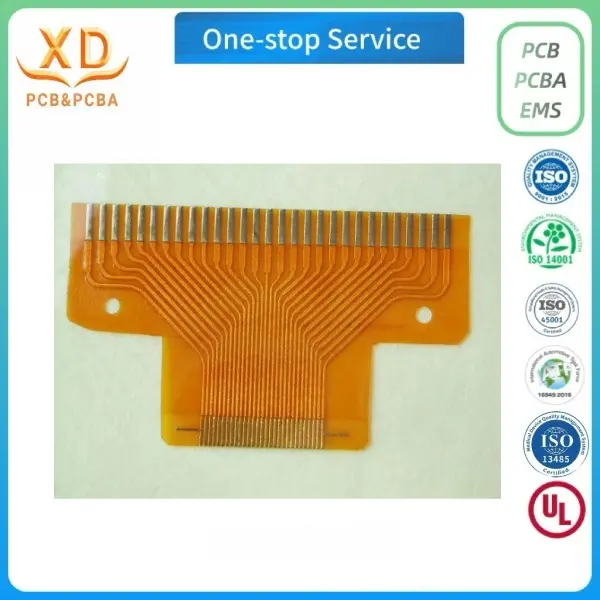
Material Selection for Custom Flexible PCB Projects
Material selection is one of the first technical areas that should be reviewed with a manufacturer.
Flexible circuits commonly use flexible dielectric materials that allow the circuit to bend. Polyimide is widely used in FPC construction, while copper serves as the conductive layer. However, the appropriate material structure depends on the product's electrical, thermal, mechanical, and manufacturing requirements.
A supplier should be able to discuss material selection in relation to the actual application rather than simply offering a standard material combination.
Important considerations may include:
Flexibility
The substrate and conductor structure need to support the intended bending conditions. A circuit designed for one-time folding may have different requirements from a circuit that repeatedly moves during operation.
Temperature
The operating and assembly temperature range can affect material selection. Reflow soldering and other manufacturing processes also need to be considered when components are assembled on the flexible circuit.
Electrical requirements
Signal frequency, impedance, current requirements, trace geometry, and layer structure can influence the appropriate material and board construction.
Mechanical structure
The FPC may need to pass through narrow spaces, fold around components, or connect two separate sections of a product. The material structure should match the mechanical design.
Manufacturing compatibility
The selected materials must be compatible with the manufacturer's fabrication and assembly processes.
For this reason, material selection should take place during the engineering review rather than after the PCB layout has been finalized.
Design Review Capability Matters for Custom FPC
A strong flexible PCB manufacturer should do more than accept Gerber files and begin production.
Design review is especially important for FPC projects because electrical and mechanical requirements are closely connected.
For example, a circuit may appear electrically correct but still create manufacturing problems if traces are routed through an area that experiences repeated bending. A connector section may also require additional mechanical support depending on the installation method.
A supplier's engineering review should consider areas such as:
Trace routing in bending zones
Bend radius
Copper distribution
Layer transitions
Via placement
Component placement
Connector areas
Stiffener requirements
Board outline
Clearance
Manufacturing tolerances
Assembly constraints
The objective is not to redesign the customer's product unnecessarily. It is to identify potential manufacturing and reliability issues before they become production problems.
For OEM projects, this early review can reduce engineering changes later in the production cycle.
Static Folding and Dynamic Bending Require Different Planning
The word “flexible” covers several different mechanical conditions.
A flexible PCB may be folded once during product assembly and then remain in a fixed position. Another application may require the circuit to bend repeatedly while the product operates.
These two situations should not be treated as the same manufacturing requirement.
Static bending
Static bending refers to a circuit being formed into a particular position and remaining there during normal operation.
Examples may include:
Compact electronic housings
Folded internal routing
Curved product structures
Cable replacement applications
Dynamic bending
Dynamic bending occurs when the flexible circuit repeatedly changes position.
Examples can include:
Moving printer mechanisms
Folding electronic structures
Certain sensor assemblies
Controlled moving interfaces
Dynamic applications require more attention to mechanical design because repeated movement can place stress on the conductive layers and transition areas.
A manufacturer should therefore ask about the expected bending direction, bend radius, movement frequency, operating environment, and expected service conditions before recommending a manufacturing structure.
This is one reason a supplier's engineering communication can be as important as its fabrication equipment.
Trace Routing and Bend Area Design
The flexible section should not be treated as an ordinary rigid PCB area.
Trace routing can affect how the circuit behaves during bending. Sharp routing changes, concentrated copper distribution, and inappropriate feature placement can create mechanical stress in areas that need to flex.
A flexible PCB manufacturer should review:
Trace direction
Trace spacing
Copper distribution
Bending zones
Via locations
Layer transitions
Component placement
Connector positions
Where repeated bending is expected, the design should be developed around the actual movement pattern.
The mechanical structure of the finished product should also be considered. A PCB that bends correctly on a workbench may experience different forces after installation inside a housing.
For this reason, prototype evaluation should ideally include the actual product assembly conditions rather than testing the bare FPC alone.
FPC Manufacturing Capability and Production Consistency
A manufacturer may successfully produce prototypes but face different challenges when production volume increases.
For OEM buyers, production consistency is therefore an important supplier-selection factor.
The evaluation should cover:
Production equipment
Process control
Material management
Manufacturing tolerances
Inspection procedures
Yield management
Traceability
Production capacity
Engineering support
Prototype-to-production transition
The specific equipment and process controls should be evaluated against the project's actual requirements rather than treated as a checklist of generic capabilities.
A supplier experienced with custom flexible circuits should also be able to explain which design features create manufacturing difficulty and how those issues can be addressed.
Prototype Production Before Mass Manufacturing
Prototype production is particularly valuable for flexible PCB projects because the final board must fit both the electrical design and the mechanical structure.
A prototype can help verify:
Board dimensions
Connector position
Folding direction
Bend radius
Component clearance
Housing fit
Assembly sequence
Electrical connections
Prototype evaluation should ideally take place before the project moves directly into high-volume production.
For OEM buyers, the supplier should also clarify whether the prototype process uses the same basic manufacturing approach expected for production. Significant differences between prototype and mass-production processes can create additional engineering work during the transition.
A clear prototype-to-production process can make later design revisions easier to manage.
Flexible PCB Assembly and Component Sourcing
Some projects require an FPC only, while others require a complete flexible PCBA.
This distinction should be established before supplier comparison.
If the project includes components, the manufacturer may need to support:
Component sourcing
SMT assembly
Soldering
Inspection
Electrical testing
Functional testing where applicable
Final packaging
Component placement on a flexible circuit can require different planning from conventional rigid PCB assembly. Mechanical support, board handling, component locations, and connector areas all need to be considered.
For OEM buyers, a supplier that can combine PCB fabrication and assembly may simplify project coordination. However, the buyer should still confirm the actual process scope, component sourcing responsibility, testing requirements, and production control.
A one-stop manufacturing model is useful only when the supplier can maintain appropriate technical control across the required stages.
Testing and Quality Control for Flexible PCBs
Testing requirements vary according to the board design and end application.
Electrical continuity and isolation testing are common considerations for PCB manufacturing, while additional inspection or functional testing may be required for assembled boards.
For custom flexible PCB projects, testing can be considered at several stages.
Incoming material control
Materials should be checked according to the manufacturer's quality procedures and the requirements of the project.
Fabrication inspection
The finished circuit can be inspected for issues related to dimensions, traces, vias, surface finish, and other specified characteristics.
Electrical testing
Electrical testing can help identify open circuits, short circuits, or other defined electrical defects.
Assembly inspection
When components are mounted, inspection methods can be selected according to component density, package type, and product requirements.
Functional testing
For a completed PCBA, functional testing may be appropriate when the product requires verification of specific electrical functions.
The key point is that testing should be connected to the product's actual requirements. A manufacturer should be able to discuss which inspection and testing methods are appropriate for the project instead of presenting a generic list of tests.
Flexible PCB Manufacturer vs. General PCB Supplier
Not every PCB supplier has the same level of experience with flexible circuits.
A manufacturer focused primarily on rigid FR-4 boards may have strong capabilities in conventional PCB fabrication but limited experience with the mechanical and manufacturing requirements of FPC.
This does not mean every flexible PCB project requires a specialist supplier. It means buyers should verify whether the supplier has relevant experience before placing a custom order.
A useful comparison includes:
| Supplier Type | Typical Strength | Key Question |
|---|---|---|
| General PCB supplier | Conventional rigid PCB production | What FPC processes are actually supported? |
| Flexible PCB manufacturer | FPC fabrication and flexible circuit design | Can the supplier support the required mechanical conditions? |
| PCB + PCBA manufacturer | Board fabrication plus assembly | Can fabrication and assembly be coordinated? |
| Full-service OEM supplier | Multiple manufacturing stages | Which processes are handled internally? |
The most suitable supplier depends on the product's requirements and the level of manufacturing support needed.
Questions to Ask Before Selecting an FPC Manufacturer
A technical discussion before quotation can reveal important differences between suppliers.
OEM buyers can ask:
What flexible PCB structures does the manufacturer support?
Which flexible substrate materials are available?
Can the manufacturer review the PCB design before production?
How are static and dynamic bending requirements evaluated?
Can the supplier support prototype and volume production?
Is flexible PCB assembly available if components are required?
What electrical testing is available?
What inspection process is used during production?
How are engineering changes managed?
Which manufacturing processes are performed in-house?
Can the supplier support component sourcing?
How is the transition from prototype to mass production managed?
The answers should be compared against the actual requirements of the product.
A supplier that provides detailed engineering feedback before production may offer more practical value than a supplier that simply provides the lowest initial quotation.
How to Compare Flexible PCB Manufacturer Quotations
Price comparison should begin only after the technical specification is clear.
Different suppliers may quote different board constructions, materials, tolerances, testing scopes, or production conditions. Comparing only the final unit price can therefore produce misleading results.
A useful quotation comparison should include:
Board structure
Material
Layer count
Copper requirements
Surface finish
Stiffeners
Special processing
Quantity
Prototype cost
Assembly cost
Testing cost
Tooling or engineering charges where applicable
Component sourcing responsibility
Production lead time
The final purchasing decision should consider total project cost and production risk.
For example, a slightly higher PCB price may be reasonable if it includes engineering review, assembly coordination, testing, and better production support. On the other hand, additional services should not be accepted automatically if the project does not require them.
Flexible PCB Manufacturer Selection for Different Applications
The right supplier can also depend on the application.
Wearable electronics
Wearable products often require compact circuit structures and careful mechanical integration. Supplier experience with thin flexible circuits and compact assembly can be important.
Thermal printers
Printer FPC applications may involve controlled movement and repeated bending. The manufacturer should understand the mechanical requirements of the specific printer mechanism.
Medical electronics
Medical electronic products may have strict product-level requirements. PCB supplier selection should consider the customer's applicable quality, traceability, testing, and regulatory requirements rather than assuming that every medical application has the same manufacturing specification.
Consumer electronics
Slim housings, compact internal routing, and high-volume production may make flexible PCB technology attractive for consumer products.
Industrial electronics
Industrial applications may place greater emphasis on operating environment, mechanical durability, temperature, and long-term production consistency.
The application should therefore be part of the supplier-selection discussion from the beginning.
A Practical Checklist for Choosing a Flexible PCB Manufacturer
Before approving a supplier, OEM buyers can use the following checklist:
| Requirement | Evaluation |
|---|---|
| FPC fabrication | Required board structure supported |
| Material capability | Materials match application requirements |
| Design review | Engineering review available |
| Bend requirements | Static/dynamic conditions evaluated |
| Prototype | Prototype production supported |
| Mass production | Expected production volume supported |
| Assembly | PCBA capability available if required |
| Testing | Appropriate electrical and inspection methods |
| Component sourcing | Available when required |
| Engineering communication | Clear technical response |
| Quality management | Defined production and inspection procedures |
| Cost structure | Quotation scope clearly defined |
This approach helps move supplier selection away from a simple price comparison and toward a complete manufacturing evaluation.
The right flexible PCB manufacturer should be evaluated according to the complete product requirement, not only the ability to fabricate a flexible circuit. Material selection, bend conditions, routing, board structure, prototype production, assembly, testing, and volume manufacturing all influence the success of a custom FPC project.
For simple flexible interconnections, fabrication capability may be the primary concern. For more complex OEM products, engineering review and production integration become increasingly important. A supplier that can evaluate both the electrical and mechanical sides of the design can help identify manufacturing issues before they affect production.
Xing Da's current product portfolio includes flexible PCB and rigid-flex PCB solutions, with FPC applications covering areas such as wearable devices and printers.
For custom flexible PCB, FPC assembly, or OEM manufacturing requirements, Contact Us with the board design, application, expected quantity, and technical requirements for project evaluation.
Label: